

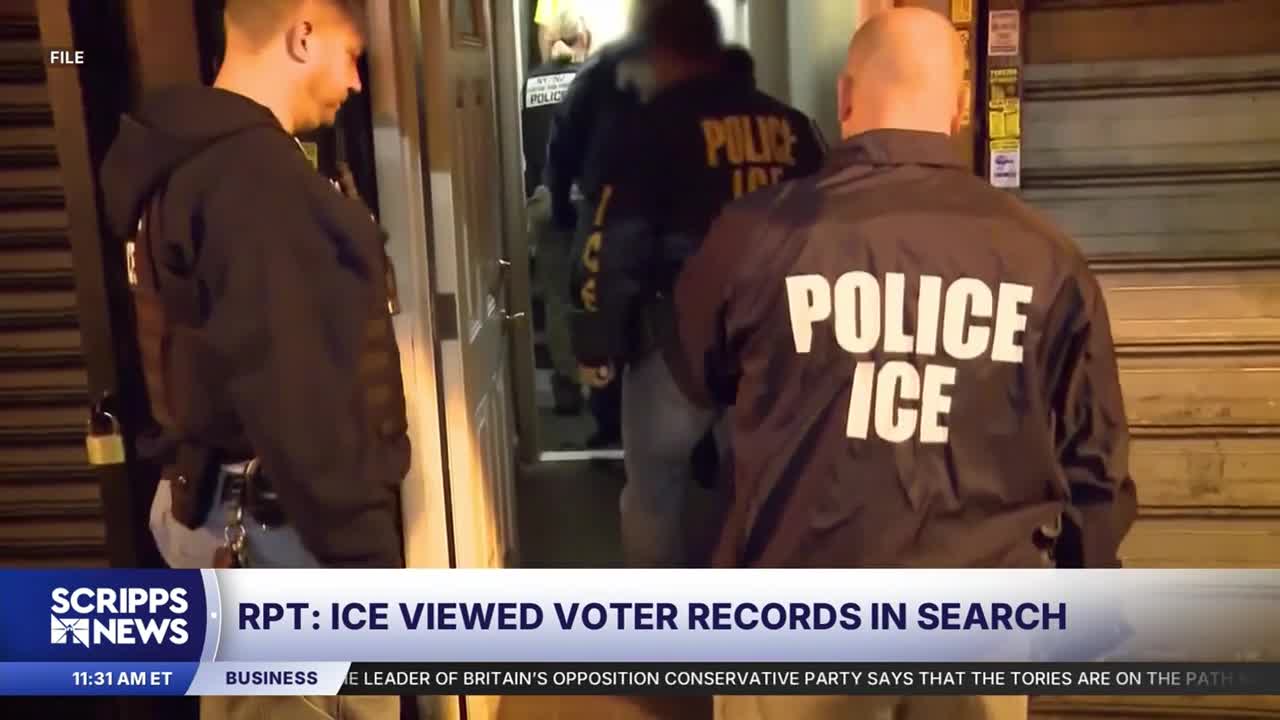


The Department of Homeland Security’s sweeping election-fraud operation has drawn on tens of millions of records, scrutinized dozens of nonprofit voter-registration groups and considered deploying undercover agents to investigate organizations suspected of helping noncitizens register to vote, according to newly obtained internal documents.
The 166 pages of records, released on Wednesday by the advocacy group Democracy Forward, offer a detailed look inside one arm of the Trump administration’s escalating election-integrity campaign, which has marshaled federal investigators, immigration databases and voter records in an effort to identify noncitizens suspected of illegally registering or voting. They show the extensive infrastructure the administration has built within its immigration enforcement agency to pursue probes aligned with Trump’s election fraud beliefs, with multiple layers of data reviews, dozens of organizations investigated, primary elections tracked and weekly reports summarizing the progress of the various projects.
Homeland Security Investigations, the investigative division of US Immigration and Customs Enforcement, described the undertaking as a phased national initiative involving voter-roll acquisition, data analysis, investigative leads and field investigations.
The operation drew on extraordinarily large pools of data. A June 1 HSI report said investigators had ingested 50.6 million records from a Justice Department dataset and another 48.4 million records that Heather Honey, a senior counselor to Homeland Security Secretary Markwayne Mullin, had obtained through what the report called “independent sources of information.”
The document does not identify those independent sources, but the data may include public voter lists from California, New Jersey, Pennsylvania and Nevada that DHS purchased and analyzed around this time.
In July, Mullin announced that his department found roughly 250,000 noncitizens registered to vote in just those four states — claims that officials in those states have repeatedly challenged.
The 50 million Justice Department records may include unredacted voter lists voluntarily handed over by more than a dozen Republican-led states in the months prior. DOJ has sued 30 other states to force them to share their unredacted rolls for audit.
In a statement, a DHS spokesperson said: “DHS has been incredibly transparent about the acquisition and the analysis of publicly available voter files conducted by the Fraud Detection and National Security Directorate of USCIS. DHS and DOJ are laser focused on prosecuting and removing aliens who vote and preventing the dilution of the votes of US citizens.”
Democracy Forward President and CEO Skye Perryman said in a statement: “It appears the president and his allies want to pick their voters, as opposed to the way things are supposed to function in a democracy where voters pick their leaders.”
The documents suggest that the Trump administration is using data-review products offered by the controversial software company Palantir for its reviews of voter rolls. The agency is using a Palantir tool known as ELITE to process state voter rolls, according to a July election probe progress report in the trove. Palantir’s website describes ELITE as a “data integration” tool with the purpose of “identifying the location of known foreign nationals who meet criteria for removal.” CNN has reached out to Palantir for comment.
RELATED STORY | Chicago woman who was shot 5 times by immigration agent files lawsuit alleging he fired from behind
Probing voter registration organizations
The documents also show that investigators were looking well beyond individual suspected voters. An internal comparison said HSI was adopting a “network-based investigative approach, prioritizing organization and facilitation analysis over individual leads.” Investigators reviewed dozens of nonprofits and voter-registration organizations in Pennsylvania, New Jersey and other states and examined organizations linked to an Ohio company suspected by investigators of voter-registration fraud.
Many of those reviews turned up no evidence of wrongdoing. Investigators said they found no derogatory information on dozens of New Jersey groups they examined, found no suspicious financial activity in another nonprofit review and closed a separate Ohio inquiry after exhausting its investigative leads.
But the records show that by late May, HSI and the FBI were developing investigative plans involving seven Ohio companies that investigators described as “consolidation centers” associated with Black Fork Strategies, a progressive canvassing firm that HSI alleged was connected to several noncitizens registered to vote in Cuyahoga County. On June 8, ICE notified senior officials that agents planned to execute federal search warrants and interview more than 100 current and former employees as part of their investigation into fraudulent voter registration and illegal voting.
The heavily redacted records do not explicitly identify Black Fork as the target of those warrants. But three days later, federal agents raided the Ohio Organizing Collaborative, a progressive organizing group with extensive ties to Black Fork.
HSI contemplated more aggressive investigative tactics as well. A June report said officials were exploring whether to use undercover agents to engage with organizations suspected of encouraging or facilitating illegal voter registration by noncitizens. New Jersey and Pennsylvania were identified as areas of focus. The document said undercover agents could be used to gather evidence and trace financial backing if investigators determined an organization was actively recruiting noncitizens to register.
The records show that HSI also monitored this year’s primary elections for “trends, vulnerabilities, or indicators” that agents believed “may impact election integrity.”
Updates on voter fraud probes shared with White House
The bulk of the documents contain status updates on HSI’s voter fraud-related investigations.
Most of the details are redacted, but the documents offer insights into how HSI and other DHS components were focused on trying to find voter fraud cases to prosecute.
In June, HSI officials wrote that their investigations were focused on five states: New Jersey, Michigan, Pennsylvania, Minnesota and Ohio.
Among the various voter fraud topics, HSI was investigating “Counties with 2020 Results” and “Voter Machines,” according to a May update on the probes.
It’s not clear what specifically was being investigated, though earlier this year, HSI agents contacted Arizona state officials with questions about the 2020 election in the state’s largest county, Maricopa. A set of DHS talking points included in the new trove described those interactions as “routine law enforcement coordination and information sharing.”
Mullin sent letters in August to the White House and Justice Department arguing that foreign-made components in voting machines could “potentially compromise election infrastructure at any stage of the supply chain.”
The investigative status updates were shared with White House officials beginning in July, according to emails from the documents.
The records also reveal how immigration enforcement gave the administration another avenue to pursue suspected noncitizen voters when a criminal case could not be brought. Internal legal guidance distributed to ICE attorneys in December 2025 said that “in cases in which the evidence is insufficient to support a criminal prosecution,” suspected unlawful voting could nevertheless make a noncitizen subject to immigration consequences. The guidance noted that certain immigration-law provisions covering unlawful voting do not require a criminal conviction and, in some circumstances, do not require proof that the person knew the vote was unlawful.
ICE’s Office of the Principal Legal Advisor sent out guidance about illegal voting following July reports that New Jersey mistakenly added 6,600 non-citizens to its voter rolls, and nearly 400 cast ballots.
ICE officials wrote noncitizens who voted could be deported under the Immigration and Nationality Act. “There is no requirement that the alien have knowledge that he or she has illegally voted, and no conviction is required,” the guidance stated.
“HSI is heavily working these cases,” ICE Deputy Director Charles Wall wrote in a July email.
RELATED STORY | Renee Good's family sues US government, immigration officials over her killing
The records also detail separate investigations of “anti-ICE” groups in Minnesota, where a massive federal immigration-enforcement operation earlier this year sparked widespread protests, particularly after federal agents fatally shot two Americans. Internal reports describe undercover agents infiltrating and surveilling activist groups as HSI investigated alleged stalking, doxing and other activity targeting immigration officers.
By late May, HSI had opened 418 voter-fraud cases and made 64 administrative arrests. But 318 of those cases had not been referred for prosecution. Investigators had also distributed more than 1,500 leads generated from immigration records to field offices across the country.
The-CNN-Wire
™ & © 2026 Cable News Network, Inc., a Warner Bros. Discovery Company. All rights reserved.
