

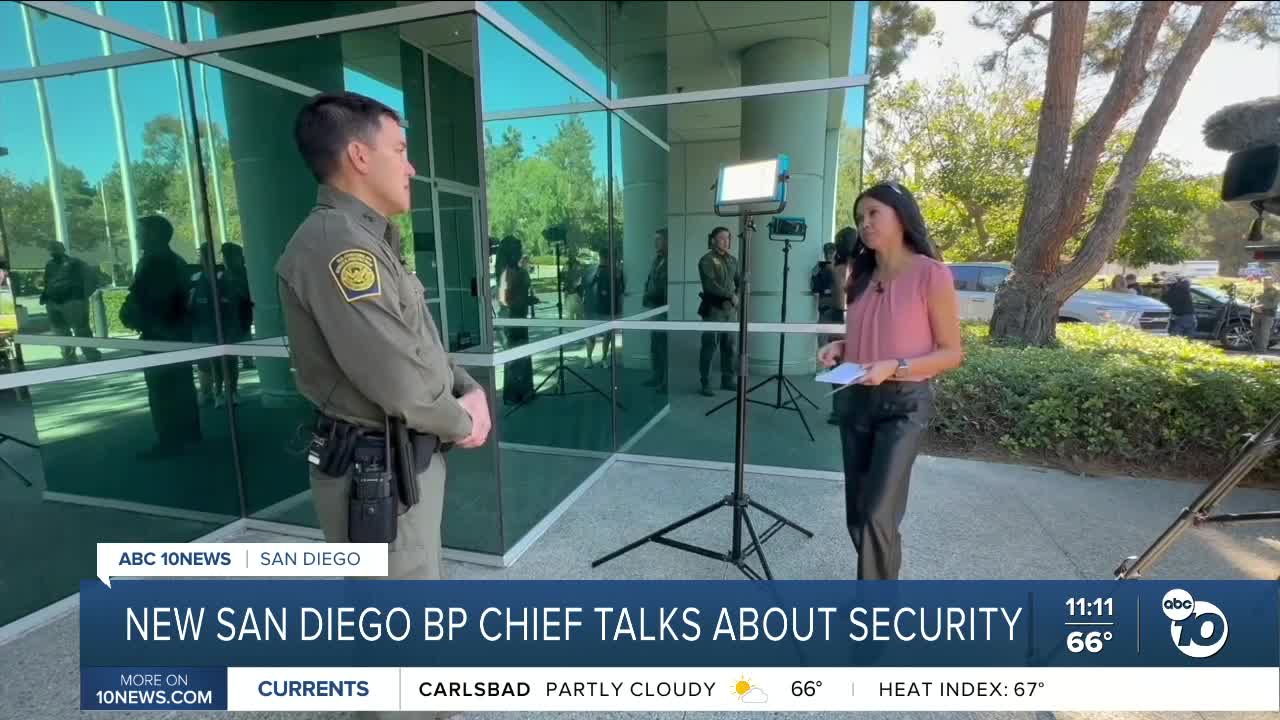


SAN DIEGO (KGTV) — It’s a homecoming for Justin De La Torre, who was recently announced as the new Chief Patrol Agent in San Diego.
De La Torre grew up in San Diego and has been with the agency since 2000, initially assigned to the Imperial Beach Station. Since then, he has worked from the southwestern border to Washington, D.C. Prior to coming back home to San Diego, he served as the Chief Patrol Agent in the Yuma Sector.
“It’s a tremendous opportunity,” De La Torre said during a recent roundtable meeting with San Diego news media. “I believe very firmly in the value of our border security mission [and] how much of an impact it has on the entire country.”
De La Torre spoke one-on-one with ABC 10News anchor Melissa Mecija about the trends along the border and the public perception of federal agencies that deal with border security during this era of President Trump’s increased immigration crackdown.
According to De La Torre, illegal crossings at the border are at a historic low.
“We’re averaging less than 30 people a day that we’re arresting for unlawful entry into the U.S. We contrast that with a couple of years ago, 2024, we were averaging almost 900 people a day illegally entering,” De La Torre said.
He said they had more than 300,000 people apprehended for illegal entry last year, with thousands more that got away.
He calls the current trends the “lowest flow of human smuggling activity in the San Diego sector that we’ve seen in decades.”
De La Torre said that the process of human smuggling is more complex and more tragic than most people realize.
“People who make the decision to come to the U.S. illegally enlist the services of the cartel to do so. They have to be smuggled into the United States and when they do that, they’re paying on average $10,000 each to be smuggled in. Those folks oftentimes don’t have that money in the first place, and they make arrangements with the cartel to work off that smuggling debt once they make it into the United States,” De La Torre said.
He said maritime smuggling rates are even higher at roughly $15,000 per person.
De La Torre said that the idea that people who are in the United States illegally have no criminal record is misleading.
“If you illegally enter the country, that is a crime. I’ve heard many people say it isn't. It is, and it has been a crime for quite a long time, even since the Immigration and Nationality Act was enacted,” De La Torre said.
De La Torre said it is a misdemeanor for a first offense, punishable by up to a year in prison and up to a $5,000 fine.
“That’s criminal behavior … it’s common sense, right?” he said.
ABC 10News asked De La Torre about President Trump’s previous statements about going after the “worst of the worst,” with critics saying the current actions of the administration is going far beyond that.
“In terms of prioritization, you have limited resources as a U.S. government and so when we’re prioritizing what we have available, we’re going to start with the most significant offenders of whatever crime it is that they may have committed in the United States or whatever level of threat that they present to the security of our country,” De La Torre said.
He emphasized holding people accountable for violations of any federal laws.
De La Torre confirmed roughly 40 local agents are deployed across the country for various border security missions. Those cities include Portland, Los Angeles and New Orleans.
When asked about his thoughts on videos of confrontations between federal agents and the public or people they’re trying to detain, De La Torre said his agents are highly trained on how to carry out missions “safely and professionally.”
Border Patrol works with Immigration and Customs Enforcement, but De La Torre did not speak specifically to any of ICE’s current operations.
The agency plans to hire roughly 800 agents in San Diego over the next two or three years, according to the new San Diego chief.
