

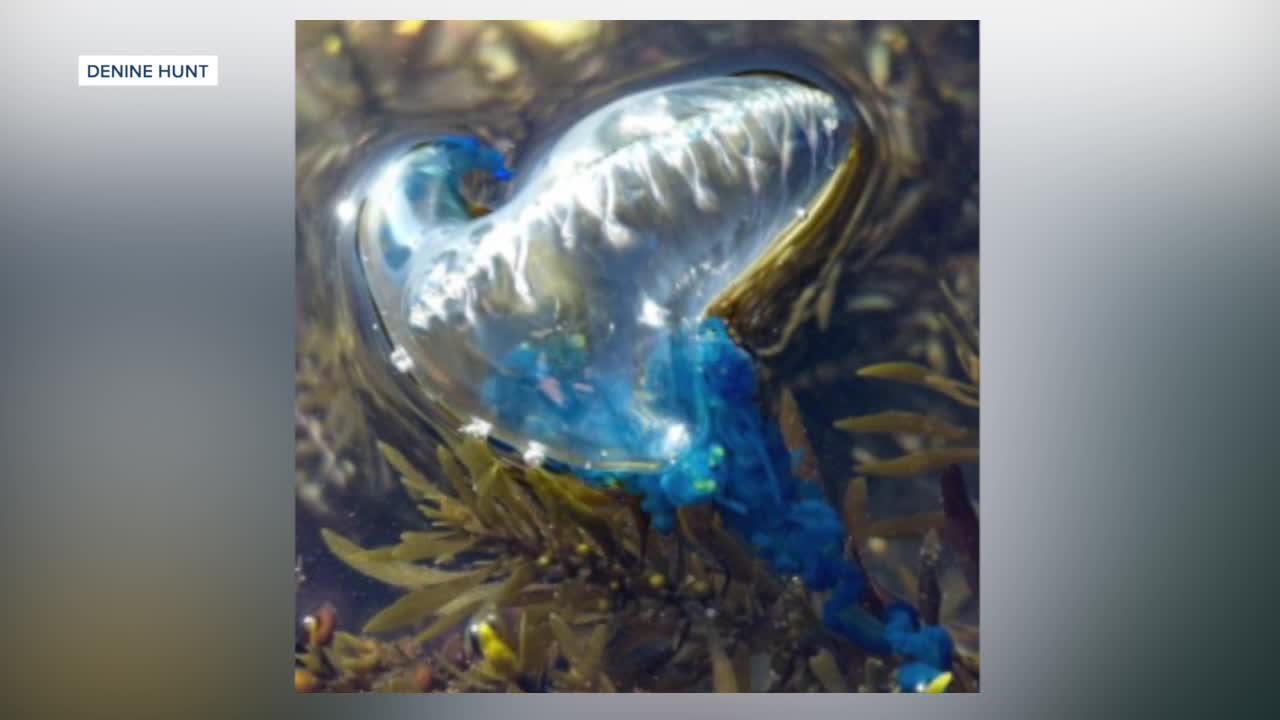


SAN DIEGO (KGTV) — A rare ocean visitor is making appearances along the San Diego County coastline, and scientists say El Niño could be playing a role.
Since late October, scientists have documented about five sightings of Portuguese man o’ wars along local shores, including near the Cabrillo tide pools and beaches in Del Mar and La Jolla, according to Linsey Sala, a senior museum scientist at the Scripps Institution of Oceanography at UC-San Diego.
The bluish or purplish creatures are related to jellyfish and are more commonly associated with warmer waters, including areas near Hawaii and Australia. Portuguese man o’ wars drift with ocean currents rather than swimming on their own.
“With the El Niño and the warmer waters from the south or offshore from the west we are experiencing, [that] may be why we’re seeing these more tropical animals visiting our shores in Southern California,” Sala said.
Although their unusual appearance may attract curious beachgoers, people should avoid touching them.
Sala said Portuguese man o’ wars are venomous and that the tentacles of larger specimens can stretch 30 to 100 feet. The ones discovered in San Diego have been smaller, with retracted tentacles measuring roughly 6 inches to a foot and likely damaged by the surf.
“Often times, the sting is painful,” Sala said. “Be aware not to step on the tentacles. If you have pets, pull them away.”
It is unclear whether San Diego will see more Portuguese man o’ wars as El Niño continues.
“I wouldn’t have the ability to predict that, but we should definitely keep our eyes out,” Sala said.
Anyone who spots a Portuguese man o’ war along the San Diego County coast is encouraged to report the sighting through the iNaturalist app or contact Sala at the Scripps Institution of Oceanography at lsala@ucsd.edu.
AI DISCLAIMER: This article was adapted from an original broadcast script with the assistance of artificial intelligence. The reporting, facts and quotes originated from the original news script.
