

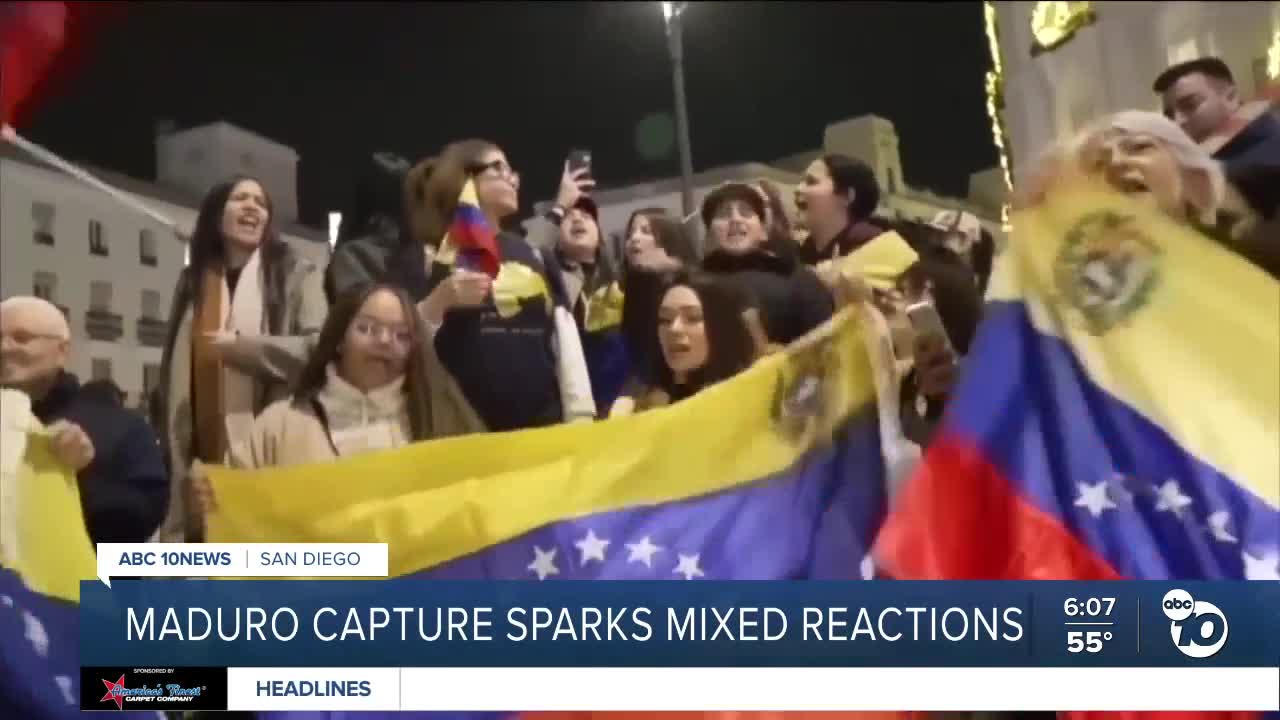


SAN DIEGO (KGTV) — Venezuelan President Nicolas Maduro is expected to appear before a U.S. judge in New York City on Monday, following his surprise capture over the weekend in a raid that also led to the arrest of his wife, Cilia Flores.
Maduro faces drug and weapons charges and is accused of leading a 25-year narco-terrorism conspiracy.
President Trump said Maduro's capture will lead to lower oil prices and fewer drugs coming to the U.S., reaffirming that the U.S. is "in control" of Venezuela. The development has created mixed reactions domestically as many wonder how the U.S. would govern Venezuela until a peaceful transfer to democracy.
The uncertainty sparked hundreds of weekend protests, and many Venezuelans in San Diego celebrated the news, calling Maduro's capture a possible turning point and remaining hopeful.
Weekend protests centered around concerns that the Trump administration targeted Venezuela not to dismantle Maduro's drug operation, but to access the country's vast oil reserves. Much of that supply currently goes to U.S. rivals like China and Russia, leading some to fear potential conflict.
Emily Von Gerichten from the San Diego Liberation Center expressed concerns about U.S. involvement.
"We don't think that money should go to endless wars. It should not go to the occupation of another sovereign country. It should go to the people's needs here in the United States," Von Gerichten said.
However, Venezuelan resident Yvette Abdulrahim had a different perspective.
"We Venezuelans are happy. I don't want the rest of the country to think that we don't want this. We needed this. It was the only way, so we are happy," Abdulrahim said. "We needed help, and it breaks my heart to see that some people believe that we don't want it. Venezuela has an opportunity to grow again and become what it was. It was a beautiful country to live in. It was a prosperous country, so we have hope."
Abdulrahim described her homeland as "sad" and full of misery. She said it was once a beautiful and prosperous place to live, but Maduro's dictatorship starved the country.
Once among the world’s richest oil producers, nationalization under Maduro sank output, collapsed the economy, and sent prices soaring — a crisis the U.N. says has driven more than 7 million people to flee since 2014.
Political and National Security expert, Ron Bee, discussed the history of Venezuela under Maduro's dictatorship, noting democratic concerns, but that 92% of the Venezuelan people want a new government.
"You'll remember Maria Machado, who received the Nobel Prize forher efforts to uh create a free Venezuela. She was not allowed to run in 2023, even though she won 92% of the vote," Bee said. "And so for those that believe in democracy, even though this may not be the usual way of going about making it happen, people will be happy about that."
The future of Venezuela remains uncertain as the country faces a potential transition following Maduro's arrest.
Bee said, "Venezuela, unlike Iraq and Afghanistan, has a history of democracy. In 1958, they overthrew a military dictatorship and had a prosperous democracy for 50 years until Hugo Chavez came in, then Nicolas Maduro. Maria Machado has written a freedom manifesto, which outlines how Venezuela can transition from that dictatorship back to a democracy."
Bee also said Venezuela could use its oil to its advantage now.
"The oil could help pay for the rebuilding of Venezuela, and it's only been. Venezuela has only been pumping out about 550,000 to 750,000 barrels a day, and that is mostly going to China and Cuba. It has the capacity for 3 million barrels a day. They did have contracts with Chevron and Exxon to get that done, but those have been put by the wayside. So I would expect that's the first thing that's going to happen."
