

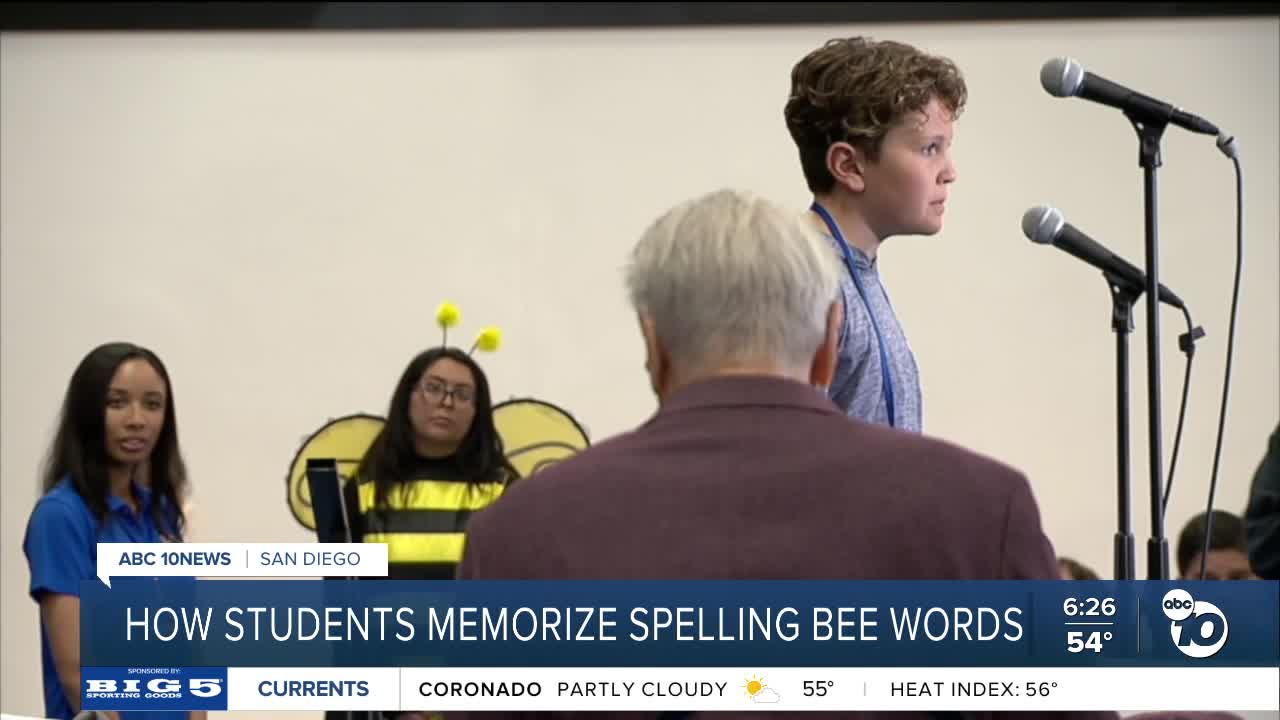


SAN DIEGO (KGTV) — Spelling Bee contestants who ask for a word's origin, definition, or for judges to use it in a sentence may be doing more than stalling — they may be using one of the brain's most effective memory tools.
The Scripps National Spelling Bee provides participants with a study guide containing 4,000 words. While that may sound overwhelming, a neuroscientist says the brain is flexible and has its own creative way of remembering language.
Stephanie Ries, an associate professor in the School of Speech, Language, and Hearing Sciences at San Diego State University, studies how the brain finds and remembers words.
"If we are able to get to the root of the word and understand where it comes from, then it's easier to remember why it's spelled that way," Ries said.
Ries said the brain is capable of retrieving words at a remarkable speed.
"When we're speaking, we actually produce about 2 to 3 words each second, and we retrieve those from a mental dictionary of 500 to 100,000 words," Ries said.
She said the brain stores words in "neighborhoods," using associated words to locate the word we want to say. She used the example of an apple.
"For apple, you maybe think of the fall, you think of that it's sweet," Ries said.
Those associated words act as neighbors, helping the brain locate both meaning and sound.
Ries said children have an advantage when it comes to learning and remembering new words.
"Children can learn much better than adults because their brains are what we call more plastic," Ries said.
For words with silent letters — like pterodactyl — Ries said students can use mental pronunciation tricks to remember every letter.
"In your head, try to remember it as pterodactyl, and however you need to pronounce it so that you remember all the letters," Ries said.
Personal connections can also help trigger the brain's memory.
"I remember that pterodactyl starts with a p because psychologist starts with a p, and I don't pronounce the p in psychologist," Ries said.
Ries said bilingual students may have an edge by drawing on similarities between languages to retrieve words — like "family" and "familia" — though those similarities can sometimes cause confusion, too.
Ultimately, Ries said spelling isn't just about memorization. It's about how the brain makes connections.
This story was reported on-air by a journalist and has been converted to this platform with the assistance of AI. Our editorial team verifies all reporting on all platforms for fairness and accuracy.
