

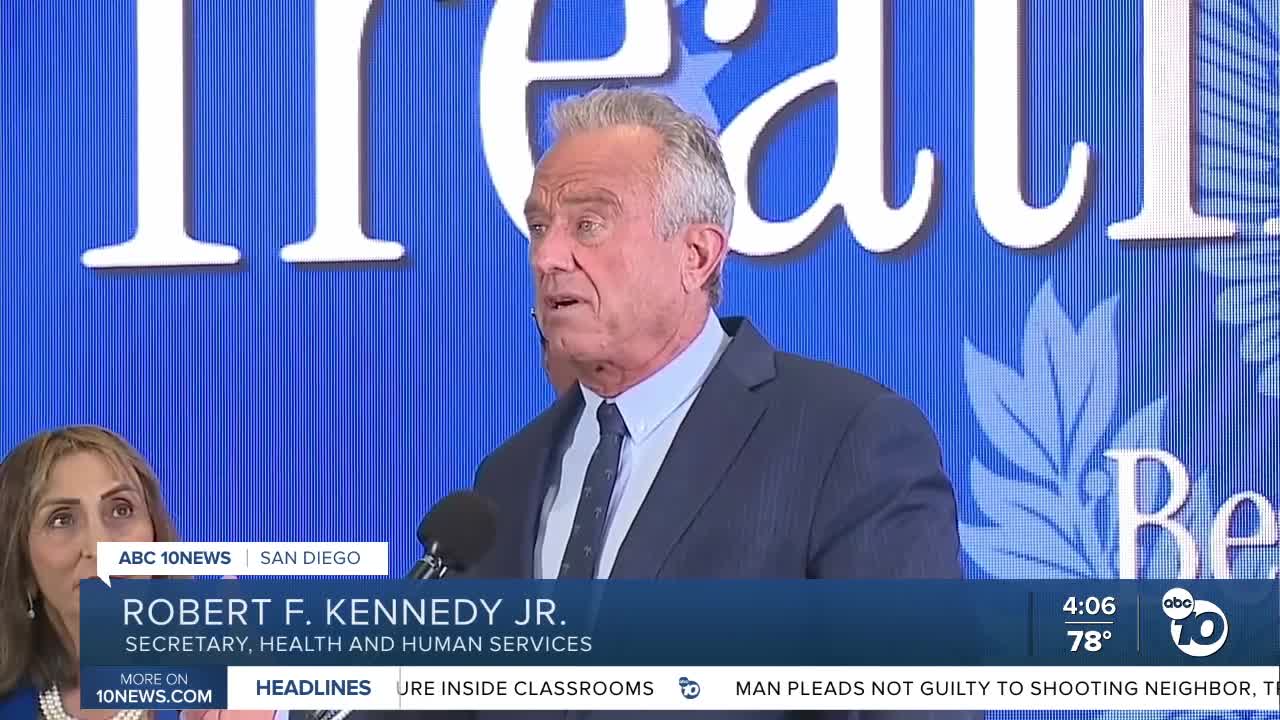


NATIONAL CITY (KGTV) — Federal officials unveiled a new approach to homelessness and addiction Wednesday at the San Diego Rescue Mission, putting treatment and recovery ahead of permanent housing.
Health and Human Services Secretary Robert F. Kennedy Jr., the White House Office of National Drug Control Policy and the U.S. Department of Housing and Urban Development announced the new “Treatment First” toolkit.
The strategy represents a shift from the federal government's previous emphasis on Housing First, which prioritizes getting people into permanent housing without requiring them to complete treatment first.
Kennedy, who has spoken publicly about his own history with addiction and said he has been in recovery for 43 years, said his experience shaped his support for the new approach.
Kennedy also criticized what he described as waste, fraud, and abuse in federal homelessness spending, arguing that taxpayer dollars have not produced the expected results.
"The principle is simple. Treatment comes first," Kennedy Jr. said. "Results must follow. That's the foundation of value-based care. We reward lasting results instead of repeated cycles of detox, relapse, and re-entry into care. Success cannot be measured simply by the number of services we supply or the amount of money that we spend. It has to be measured on whether people are actually getting better. That means sustained recovery, improved mental health, stable housing, reconnection with your families and communities, employment, self-sufficiency, efficiency, and jobs. Recovery begins when we connect people with effective care, not when we leave them trapped in addiction and homelessness."
The new toolkit outlines five phases intended to move people from homelessness and addiction toward recovery and self-sufficiency. The process begins with reaching people in crisis and stabilization, followed by treatment, primary and specialty care, early recovery and, ultimately, stable housing.
Federal officials emphasized faith-based organizations as part of the treatment-focused model.
The toolkit could also have a direct impact on organizations seeking federal homelessness funding. Going forward, organizations applying for certain federal homelessness funding will be required to use the Treatment First approach, according to language in the toolkit's official packet.
At the San Diego Rescue Mission, Outreach Director Carla Vanegas said she is a living example of how the approach can work. Vanegas shared that she was nine months pregnant and living in a drug house before entering recovery.
She said hearing the federal government was rolling out the approach nationwide brought her a sense of relief.
"The San Diego Rescue Mission believes in, you know, treatment first. We believe in rehabilitation, so we will do our best when we meet those, um, on the street. We meet them where they're at, um, and try to, try to offer our program, but if they don't, we will do our best to, to try to get them into something that they feel that fits them," Vanegas said.
During the press conference, ABC 10News asked how the "Treatment First" approach would work alongside harm-reduction programs, which provide services such as Naloxone to reverse opioid overdoses and supplies intended to reduce the risk of disease and death among people who continue to use drugs.
Officials replied, “If it means Naloxone and saving people's lives, yes. If it means giving foils to continue drug use, no."
Federal officials said the San Diego Rescue Mission was selected as the location for the announcement because it is already using a treatment-focused model.
Dr. Robert Marbut Jr., a senior adviser with HUD, said he recommended that the White House Office of National Drug Control Policy visit the San Diego Rescue Mission.
"I've been here so many times, and I've been to all three [SDRM] campuses," Marbut Jr. said. "I [told] the Office of Drug Control Policy inside the White House you need to come see the San Diego Rescue Mission. So they came. Then I said, HHS, you need to come see. So they came and so our other federal partners started looking at it and said they [SDRM] literally showcased everything we're trying to do."
The rollout comes as the Trump administration continues to push for changes to the nation's approach to homelessness, including through the Great American Recovery Initiative.
