

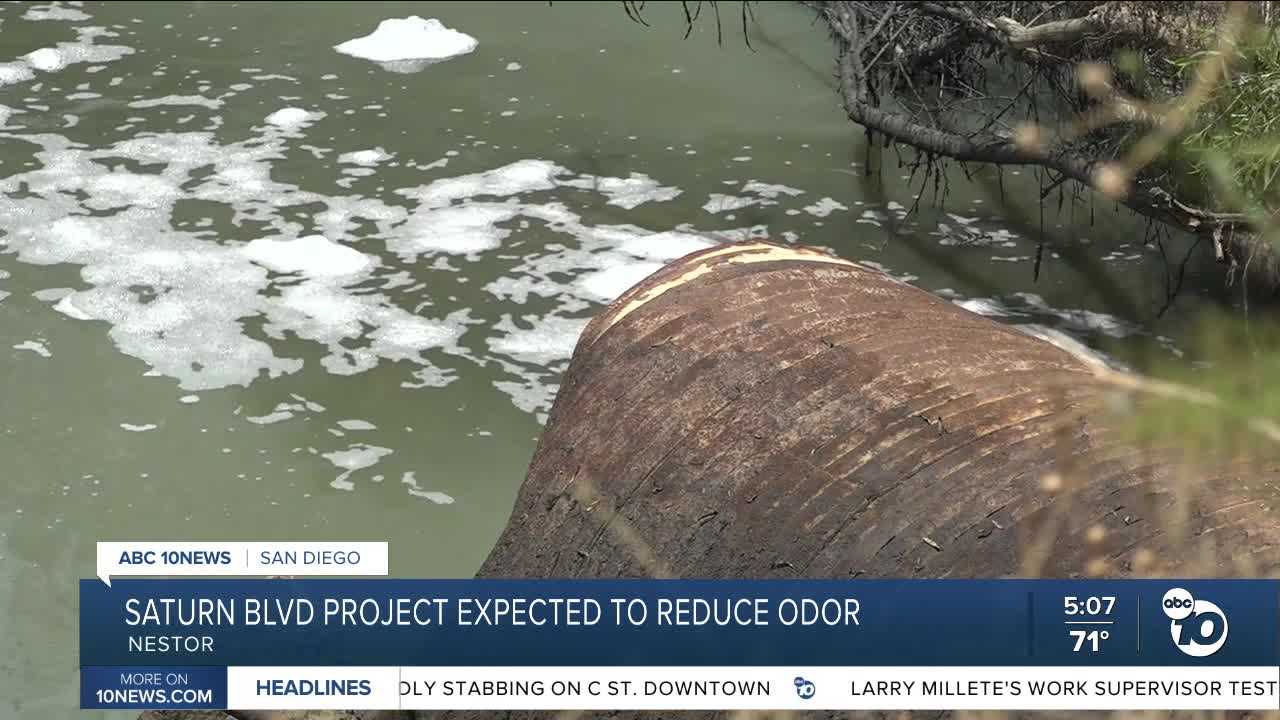


SOUTH BAY (KGTV) — Supervisor Paloma Aguirre's office announced that the California Coastal Commission has approved a permit, allowing San Diego County to begin repairs on leaking sewer pipes near Saturn Boulevard in the South Bay.
County Supervisor Paloma Aguirre is calling the future project a "major milestone" because it's expected to eliminate the foul smell and toxins that have been polluting nearby communities.
The plan calls for adding pipe extensions to damaged sewer pipes in the area. The county says the broken pipes have been leaking hydrogen sulfide gas into the air, producing a rotten egg and sulfur smell that has plagued the surrounding community.
In Aguirre's release, it explained how the project will reduce the foul smell:
"For several years, damaged infrastructure at Saturn Boulevard has allowed contaminated water to cascade into a vertical drop, aerosolizing toxic pollution and releasing harmful gases, including hydrogen sulfide, into the local atmosphere. The now-approved project will upgrade the damaged culverts by adding pipe extensions to eliminate the sharp drop, drastically reducing the airborne contaminants plaguing local residents."
Maile Heyer, a Ph.D. researcher at UC San Diego who has been studying the sewage crisis since 2023, explained how the gas is released.
"That gas is actually dissolved in the sewage water, so it's in a liquid form, and then when it hits at Saturn Boulevard, there's that waterfall, and there's this turbulence. That turbulence basically volatizes the hydrogen sulfide gas from the water into the air," Heyer said.
Heyer said there are concerns about whether the fix would simply move the problem rather than solve it.
"Reducing that turbulence will reduce the smell at that specific spot. However, the gas is still dissolved in the water. It's gonna keep traveling down the river into the estuary and eventually into the ocean, and we know with breaking waves, at the coast, that's another form of turbulence," Heyer said.
Imperial Beach resident Marvel Harrison, who lives on the ocean, echoed that concern, noting that pollution does not simply disappear.
"Matter doesn't go away," Harrison said. "Are we gonna have more hydrogen sulfide coming off the aerosolization at the beach and in the surf?"
Despite her reservations, Harrison said she is optimistic about the project because of its potential to improve air quality, especially for children in the South Bay.
"Particularly because there are so many children affected," Harrison said. "Hydrogen sulfide is a chemical warfare gas, and it is destroying neurons and the brains and hearts of these small children."
Harrison described the project as a band-aid fix and called for more comprehensive action.
"I just want to say we have to keep going to the root of the problem," Harrison said. "I believe that whatever the county, the state, whoever can do to mitigate us being poisoned, whether it's over at Saturn or whether it's here on the beach, is important, but it won't fix the root of the problem."
Aguirre's office said one long-term solution would involve building a permanent box culvert bridge and diverting the river on the U.S. side.
UC San Diego researchers say they will be able to take hydrogen sulfide readings in a year to determine whether the project is working. They have meters all over the South Bay, including at the Imperial Beach Pier and at the Saturn Hot Spot.
To check the readings, click here: https://airborne.ucsd.edu/
