

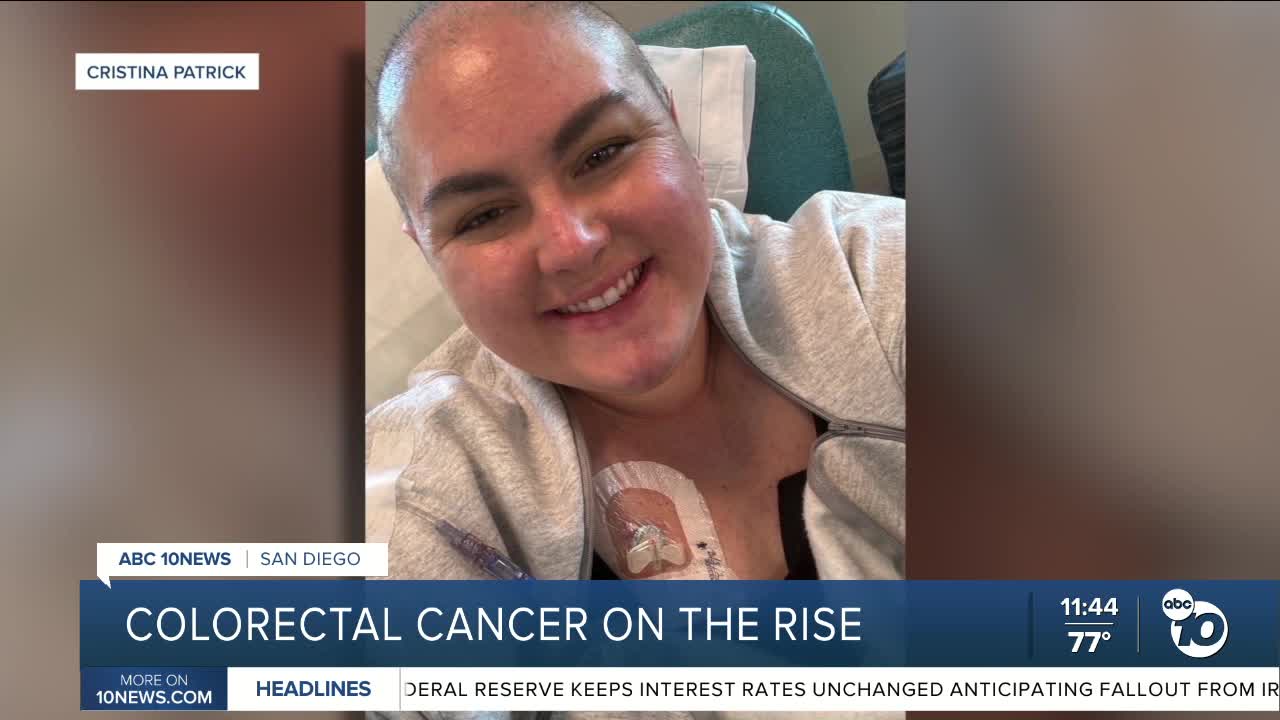



CHULA VISTA (KGTV) — Cristina Patrick, a third-grade teacher at Harborside Elementary in Chula Vista, is now in her 10th year of teaching.
It’s a job she loves, but lately, her interactions with her students involve telling them about her cancer journey.
Patrick uses kid-friendly books to explain what cancer is and how it affects people like her.
She was diagnosed in her mid-20s.
"There's so many people that are being diagnosed younger and younger now. The screening age got reduced to 45, but I was 26 when I was diagnosed. If I had waited until, I wouldn't have made it to 45 to get screened," Patrick said.
In 2020, Patrick experienced severe gastrointestinal issues, vomiting and dehydration. Doctors initially suspected a severe urinary tract infection, then later believed it was ovarian cancer. After a colonoscopy, she learned she had colorectal cancer.
Now 32, Patrick has undergone nearly a dozen surgeries and multiple rounds of chemotherapy. She said she will remain on chemotherapy for the rest of her life.
"There's times that, you know, I go home, I like to cry in the shower,” she said. “I do get emotional when I think about it … I'm so young people [and] thought this was an old man's cancer,” Patrick said.
She is no longer able to have children of her own because of the cancer. “Lots of things have changed that do make it hard, but I have a really good support system,” she said.
According to the American Cancer Society, colorectal cancer is the second leading cause of cancer-related deaths in the U.S., and it is increasingly affecting younger people.
The organization said the rate of diagnosis for colorectal cancer for people ages 50 to 64 increased by 0.4 percent per year from 2013 to 2022. For those younger than 50, the rate increased by 2.9 percent per year during that same timeframe.
Dr. Abi Olulade with Sharp HealthCare said preventing risk factors starts with your lifestyle.
"It really starts with the basic diet. Less processed foods. Also exercising," Olulade said.
Olulade also emphasized the importance of knowing your family history. Patrick had no family history of the disease, but she is sharing her experience to remove the stigma around discussing symptoms.
"It's important to look at your stool if there's blood in your stool. If it's kind of a clay color, if it's very thin, that means that there might be something in your bowel that's obstructing," Patrick said.
She believes talking about it removes some of the embarrassment around the topic.
"Being a teacher with kids, you know we talk about it all the time kids pass gas they have to go to the bathroom. So it's normal in my world but out in the everyday world. It's not normal for people to be like oh I went to the bathroom and I, you know, saw this they just kind of ignore the symptoms until it's too late," Patrick said.
Medical experts urge people to get screened. Colonoscopies are recommended starting at age 45, or earlier for those with a family history. At-home stool tests, like gFOBT and FIT, are also available.
Patrick will participate in the California Colorectal Cancer Coalition 5K on March 28 in San Diego. If you would like to donate, click here.
This story was reported on-air by a journalist and has been converted to this platform with the assistance of AI. Our editorial team verifies all reporting on all platforms for fairness and accuracy.
