

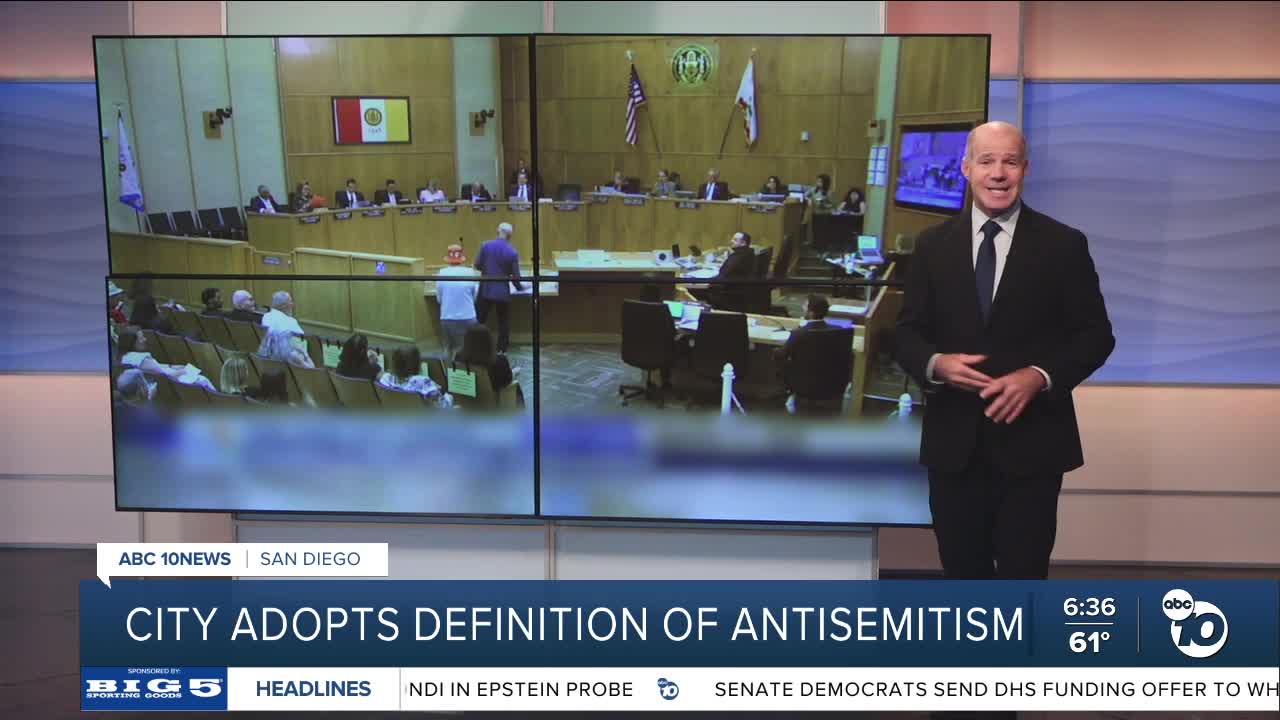

SAN DIEGO (KGTV) - The San Diego City Council passed a resolution Tuesday night adopting the International Holocaust Remembrance Alliance's definition of antisemitism, following hours of debate and public comment over what has become a controversial issue.
The final vote was 8-1, with only Councilmember Sean Elo-Rivera voting no.
Councilmember Stephen Whitburn, whose office proposed the resolution, said it's an important step to show the Council and the City support San Diego's Jewish Community.
"For far too many Jewish families, including thousands who live in San Diego, antisemitism is not an abstract concept," he said during the meeting. "It is something they live with every single day. And that is why I'm bringing this forward."
The IHRA defines antisemitism as "a certain perception of Jews, which may be expressed as hatred toward Jews. Rhetorical and physical manifestations of antisemitism are directed toward Jewish or non-Jewish individuals and/or their property, toward Jewish community institutions and religious facilities.”
It also lists 11 specific examples of antisemitism, some of which include specific criticisms of Israel.
That's where the controversy begins.
"I'm glad to see municipalities being concerned about antisemitism, as am I. I just think this is the wrong approach," says Professor Kenneth Stern, the director of the Bard Center for the Study of Hate.
Professor Stern was the lead author of the definition. He says it was intended to create a baseline for collecting data about antisemitism around the world. But in a conversation with ABC 10News anchor Jared Aarons, he says the way it has been implemented over the last few years has deviated from its initial intent.
"I understand people sincerely want to fight antisemitism. I do too. This is being seen as a symbol and as a shortcut," he says.
"If you look at how it's being, and has been used, it's been used only to suppress pro-Palestinian speech."
That was the argument from dozens of people at the City Council meeting on Tuesday afternoon. More than 200 people signed up to give public comment on the issue, both for and against the definition. That part of the meeting lasted more than 4 hours.
The Council also debated the issue for another hour and a half, ultimately passing the resolution. They also added an amendment calling for the city's Human Relations Commission to define more forms of racial discrimination to engage other communities and perspectives.
Whitburn pushed back on the idea that the definition will prohibit free speech, pointing out that the resolution specifically says "Nothing in this resolution is intended to, nor shall be construed to limit or infringe upon rights protected by the US Constitution or the CA Constitution, including the right to free speech or expression," he said. "My view is this definition of antisemitism does protect that right."
"As I read it," he added, "this definition makes a point of allowing for criticism and allowing for context."
Whitburn also pointed out the significant rise in antisemitic acts in San Diego, which went up by 150% from 2024 to 2025.
"When people are literally afraid to speak in Hebrew, that is an actual inhibition of free speech. When people are afraid to wear their Star of David, that is an actual inhibition of their religious freedom," Whitburn said. "Make no mistake, it is precisely because members of the Jewish Community in San Diego are experiencing hate in a way that restrains their speech and their freedoms that I believe we must send a message that this City Council stands with the Jewish community against Antisemitism. I think that is an important message to send, and that is what this resolution does."
Hundreds of other cities, schools, and organizations have adopted the definition. In a statement, the Combat Antisemitism Movement (CAM) called Tuesday's vote a "landmark moment" for San Diego.
“San Diego is now sending a powerful message that antisemitism has no place here," wrote CAM Chief Government Affairs Officer Lisa Katz. "We thank the City Council for their courage, their clarity, and their commitment to building a city where every resident feels safe and valued.”
Still, Professor Stern points out that the definition has led to lawsuits across the country accusing people of being antisemitic. Professor Stern says that can unfairly label people, even within the Jewish community.
"You would never take a definition that looks at a community and basically decides somebody is really not a true representative of that community," he says. "There would be Jews who are criticizing Israel in ways that may be vile of the text of the definition. Why would you want to have the City Council on record saying those folks aren't really Jews, those folks aren't, you know, expressing what it means to be Jews? You want to have that as an internal debate. You don't want to have the government deciding it...
"What I'd rather have them do is talk about things that are really critical to the Jewish community, Jewish security and funding for institutions, how to teach about anti-Semitism, how to teach about hate, how to on colleges, in particular, how do you have students who have strongly divergent views about Israel and about anti-Semitism, about Zionism have respectful and important discussions and teach about it."
