

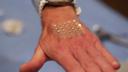

SAN DIEGO (KGTV) — Treating early-stage, non-melanoma skin cancer may now be as simple as wearing a small patch for a few days.
The patch, called CivaDerm, is about the size of a Band-Aid and uses palladium-103 isotopes that emit gamma rays to treat non-melanoma skin cancer. Doctors at UC San Diego Health were among the first in the country to use it after it received FDA approval.
"This is a new option that requires much less time spent in the department, recurring visits where patients have to come back, dealing with parking, dealing with scheduling," said Dr. Austin Hopper, a physician at UC San Diego Health. "So it's a convenient, good option for patients."
According to the Skin Cancer Foundation, about 5.4 million cases of non-melanoma skin cancer are diagnosed each year in the United States. CivaDerm is reported to be 95% effective at treating it.
For patients like Dale Creek, the new treatment is a welcome change. Creek grew up surfing in Santa Barbara in the 1950s and 1960s and later served in the Marine Corps in Vietnam for three years — spending much of his life in the sun.
"I have been unfortunate enough to have literally hundreds of skin cancers," Creek said.
He has undergone radiation, scraping procedures, surgeries, and lengthy recoveries over the years.
"It is frustrating, and it is a large part of my life gets eaten up by having to deal with the treatments," Creek said.
Creek was the first patient to receive CivaDerm at UC San Diego Health, with the patch applied to cells on his temple and the back of his head. He had a personal reason to trust the medical team — Dr. Hopper is his stepson.
"When this became available, he has always kept me at the forefront of his treatment plans and being able to help me," Creek said. "And for that, I will always be thankful."
For Hopper, the moment was equally meaningful.
"It was fantastic. It was exciting. It felt great," Hopper said.
Patients wear the patch for about five days while going about their normal routines. Dr. Dan Scanderveg, who also works with the team at UC San Diego Health, said shielding is applied over the patch to make it safe for people around the patient.
"They can walk around day to day for about five days, and it's perfectly safe for everyone around them," Scanderveg said.
Side effects include redness, irritation, and peeling, similar to a sunburn.
Creek described the experience as the easiest treatment he has ever been through, despite initial hesitation.
"The thought of having a radioactive device glued to your head is scary for a lot of people, and it should be," Creek said. "But the directions and the application are the easiest treatments I've ever been through."
Creek said he hopes others facing similar diagnoses will explore their options.
"I am a cancer survivor, in many, many ways," Creek said. "And folks, there are treatments out there for this."
Doctors recommend checking with a dermatologist regularly to catch any skin cancer early and to discuss which treatment option is best for each individual patient.
This story was reported on-air by a journalist and has been converted to this platform with the assistance of AI. Our editorial team verifies all reporting on all platforms for fairness and accuracy.
