

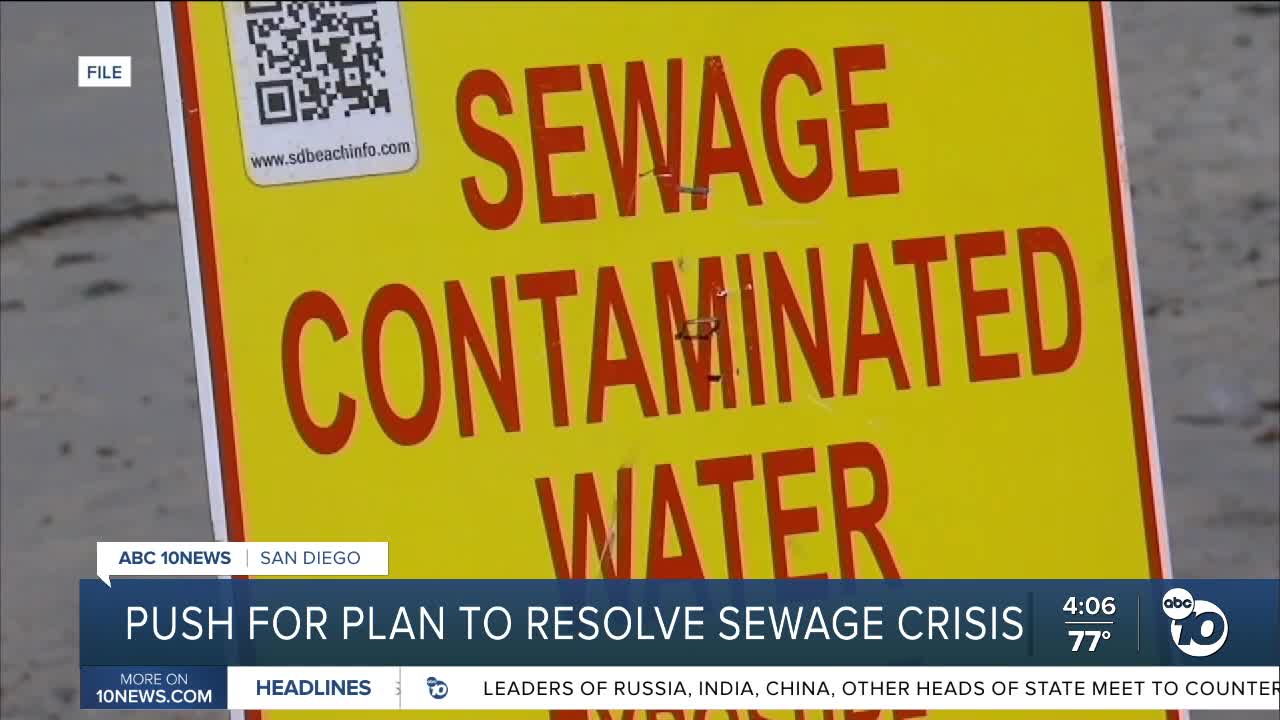


SAN DIEGO (KGTV) – San Diego County Board of Supervisors Paloma Aguirre and Terra Lawson-Remer are hoping to forward a plan approved to allow the County to take action and ownership of addressing the Tijuana sewage crisis.
“What is the issue that you hear about everywhere you go? And I tell them, it's the Tijuana River sewage crisis,” Lawson-Remer said.
It’s an issue that’s been around in the South Bay for decades.
“As a mother, this is personal for me. My daughter has asthma and has developed pneumonia twice following her severe asthma exacerbations,” Virginia Castellanos, a parent and school nurse, said. “Her doctors believe that hydrogen sulfide and poor air quality in our community are triggering and worsening her asthma.”
These two supervisors are putting two items at Tuesday’s Board of Supervisors meeting to capture, clean and solve the wastewater issues.
“Together we put $5.8 million of County funding, of our own funding, of the people's funding. So that we can get the situation under control to work and on US soil. Let me be clear, on US soil so we don't have to depend on our neighbors to the south for solutions,” Aguirre said.
Part of that nearly $6 million is to address the infrastructure at Saturn Boulevard to fix the sewage water issues there.
The other is a three-phase plan, which starts with an 18-month-long, nearly $2 million study figuring out how, what, and the cost that’ll take.
“The first time this county will build infrastructure to capture and treat the polluted river itself here on our side of the border. This isn't another study of the problem,” Aguirre said.
“What we want to do is look at the various, different options so that we can choose the most cost-effective and fastest,” Lawson-Remer said.
Now, the funding for this cleanup initiative could come from various revenue sources like ballot measures and funding from Sacramento and Washington, D.C.
ABC 10News asked Supervisor Aguirre for her response on taxpayer money being spent on how to solve the problem without knowing how it can be funded.
“I think it's money well invested because even if the ballot measure doesn't pass, even if we don't get the money from the state, at least we'll have a clear plan that has been approved by the, hopefully will be approved by, board of supervisors to continue to advocate for more funding and find other sources of funding to fix the problem here,” Aguirre said.
