



NESTOR (KGTV) — Living under the smell of hydrogen sulfide has become the norm for many South Bay residents. Simply, they feel as if they can't escape it. The data from UC San Diego's Airborne Institute shows that.
According to data from UC San Diego, for almost half of March and April, hydrogen sulfide came in overnight at levels above what the state considers safe. The state's threshold is 30 parts per billion. On Tuesday morning, levels exceeded 1,400 parts per billion.
The putrid, rotten egg smell seeps into the nearby communities heavily at night. All of it, sourced from what is considered "the hot spot" of the sewage crisis in Nestor off Saturn Boulevard.
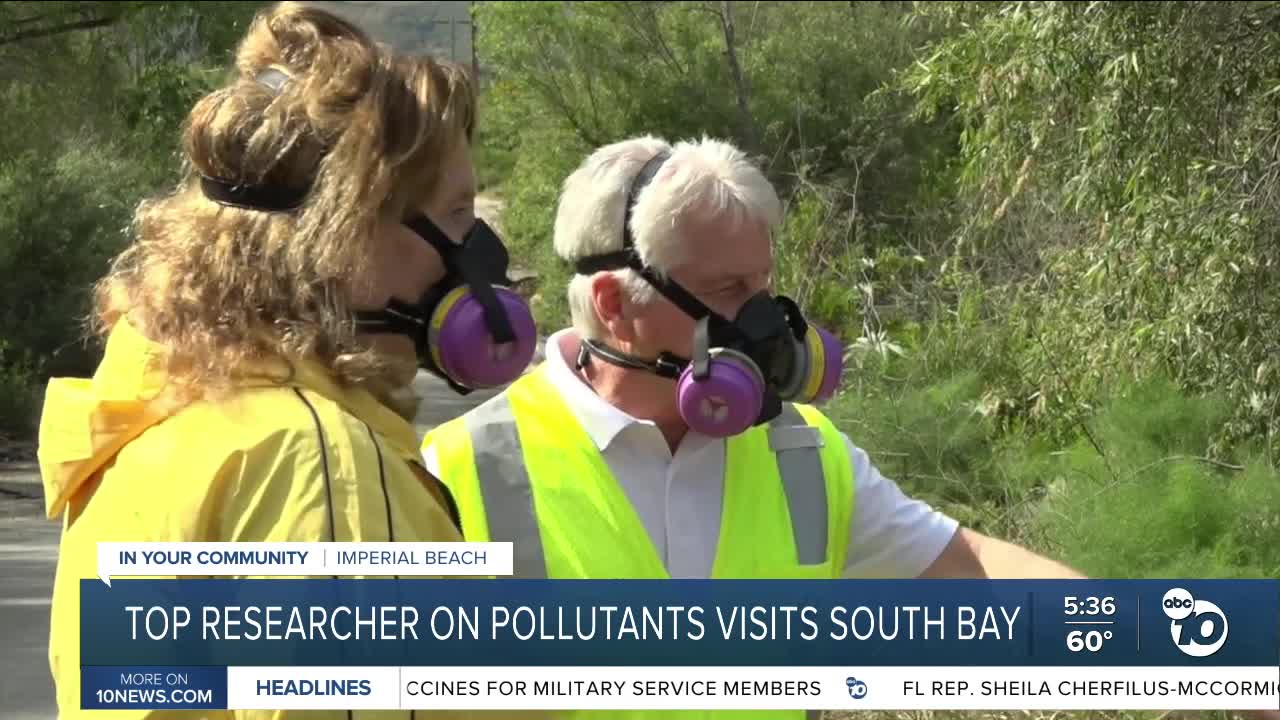
"I wouldn't go near that river without a respirator," UCSD Professor Dr. Kimberly Prather said. "My students, they put on full biohazard suits".
Prather explained one of the disappointments about this crisis continuing in the South Bay is how it takes away from what the region has to offer.
"It was stunning to me to come out and see the flowers. You see the flowers, there's cacti blooming. There are wild flowers everywhere," Prather said. "It's unbelievably beautiful here."
Despite the natural beauty, the environmental reality is stark.
"This is the worst air I've ever seen in my life," Prather said.
Prather is now bringing in backup to find a solution. Extreme Microbiome Project Microbiologist Scott Tighe is a renowned researcher with over 40 years of experience and has traveled the world studying pollution hot spots.
He has helped solve hydrogen sulfide issues around the world, including in Flagstaff, Arizona, where wastewater was dumped into residential lakes back in the 1980s.
"That was our mission [in Flagstaff], to cure the lab, to cure the smell, the hydrogen sulfide gas, and that took about two years to fix," Tighe said.
After receiving an invitation from Dr. Prather, Tighe visited the hot spot in Nestor for the first time. He says the smell of the hydrogen sulfide in Nestor "knocked him off his feet" when smelling it for the first time.
"I've been in high sulfur-containing environments and caves in Romania and various places where I see hydrogen sulfide gas bubbling out of rivers, but it's nothing like this," Tighe said.
Like many residents in the South Bay, Tighe questions the level of urgency dedicated to fixing this decades-long issue.
"I would not imagine an issue like this not being addressed. There's a level of irresponsibility for it," Tighe said.
Fixing the issue is not cheap, Tighe says. However, he believes the most cost-effective approach is focusing on the hot spot at hand before focusing on other infrastructure needs.
"This should not happen in the United States, so this can be addressed, and it doesn't have to go that far. Period. End of story," Tighe said. "If nothing else, this should be taken care of".
Pressure is growing for Gov. Gavin Newsom to declare a state of emergency, including open letters from Dr. Prather and petitions asking the governor to make the declaration.
A declaration would help speed up the process, by passing red tape, of unlocking Prop 4 funding dedicated to the Tijuana River Valley for infrastructure projects, including at the hot spot in Nestor.
In a statement to ABC 10News, a spokesperson from the governor's office says the responsibility lies in the hands of the federal government, not the state, since it deals with international boundaries.
"Look no further than the wastewater treatment plant [ibwc.gov] responsible for the Tijuana River: it's a federal facility, making the federal government directly responsible for both the infrastructure and the fix," Spokesperson Tara Gallegos said.
The statement added that California "will assist the federal government in moving federal responsibilities forward". The statement does not say whether the Governor will consider declaring a state of emergency before Newsom's departure.
Tighe has now committed to assisting Dr. Prather and her team with their research in the Tijuana River Valley. With under nine months left in Newsom’s term, Prather plans to use all her current data and new research to keep pushing for the declaration, no matter the administration.
"I'm not stopping until this is solved," Prather said. "It will be solved".
This story was reported on-air by a journalist and has been converted to this platform with the assistance of AI. Our editorial team verifies all reporting on all platforms for fairness and accuracy.
