

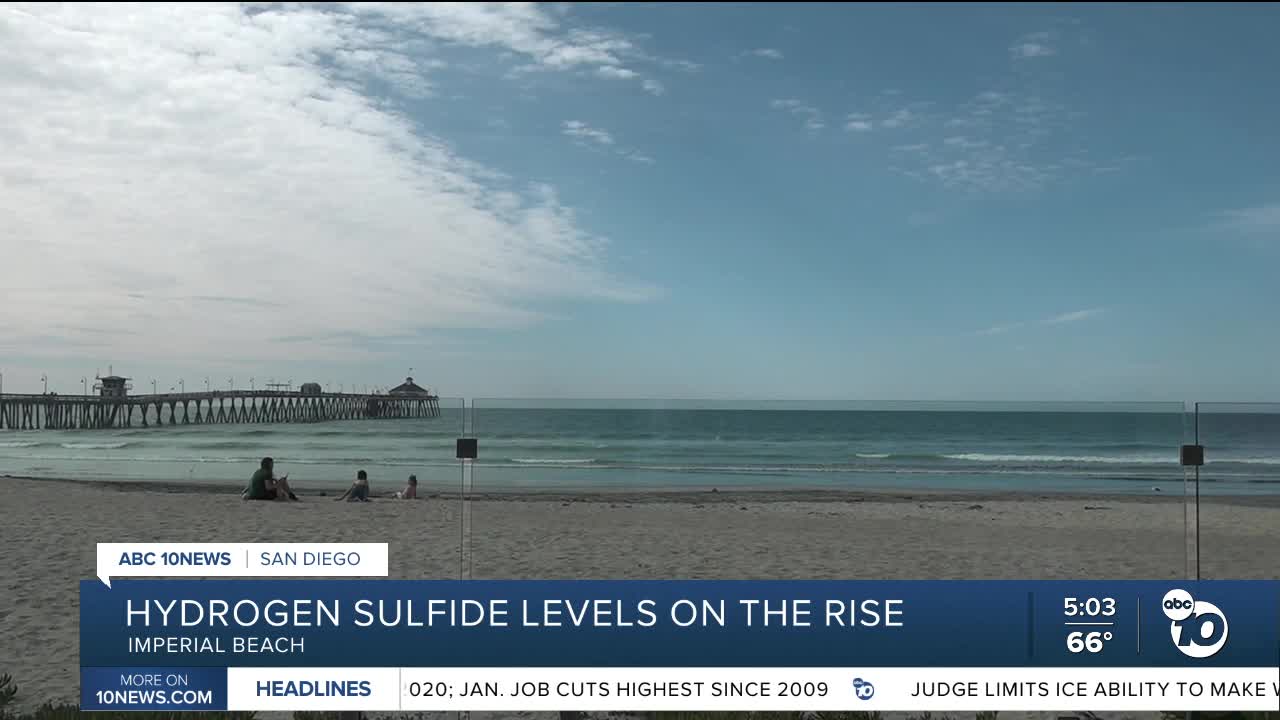


IMPERIAL BEACH, Calif. (KGTV) - Hydrogen sulfide levels in the South Bay are climbing again after months of improved air quality, raising health concerns for residents dealing with the ongoing Tijuana River sewage crisis.
At Tom Csanadi's home in Imperial Beach, an air purifier runs 24/7 amid the crisis. Recently, it's been dialed up to full speed.
"Every morning, gingerly go outside and get a smell," Csanadi said.
His decision to emerge from his beachfront home depends on what he smells and the readings from his hydrogen sulfide monitor.
"At its worst, it's like walking to a potty in an outdoor concert in the desert. You just can’t get away from it,” Csanadi said.
Across the region, hydrogen sulfide levels are on the rise again. Kim Prather, an atmospheric chemist at UC San Diego, is leading an air testing project.
"About a year and a half ago, is when we had the really high levels when he first started doing the measurements," Prather said.
After peaking at about 4,000 parts per billion, hydrogen sulfide levels spiked again this past March, and then in May and June. According to the EPA, prolonged exposure to anything above 1.4 parts per billion can make someone sick.
"We do get sluggish, headaches, start coughing. My wife had to cut short a walk last week," Csanadi said.
In August, the expansion by 10 million gallons per day of the South Bay International Wastewater Treatment Plant was completed. During a six-month span, hydrogen sulfide levels dipped before they picked up again around Christmas time.
Prather says while recent rains likely led to some sewage flow, it doesn't explain most of it.
"It comes in bursts, and it's usually, it's almost always related to the flow of the river, and we can't control that. We don't know who's controlling it, honestly… right now the flows are ridiculous," Prather said.
With more expansion scheduled at the wastewater treatment plant, Prather is hopeful hydrogen sulfide levels will head back down.
"It will reduce some of the chemicals, but it won't reduce all of the chemicals because it won't touch the industrial chemicals," Prather said.
Prather says her testing has also detected many other toxic chemicals tied to the Tijuana River flow.
Back at Csanadi's home, the return of the stink means his frustration has also returned.
"Emotionally, it wears you down," Csanadi said. "At a point, we question do we matter, how much does this community matter."
This story was reported on-air by a journalist and has been converted to this platform with the assistance of AI. Our editorial team verifies all reporting on all platforms for fairness and accuracy.
