

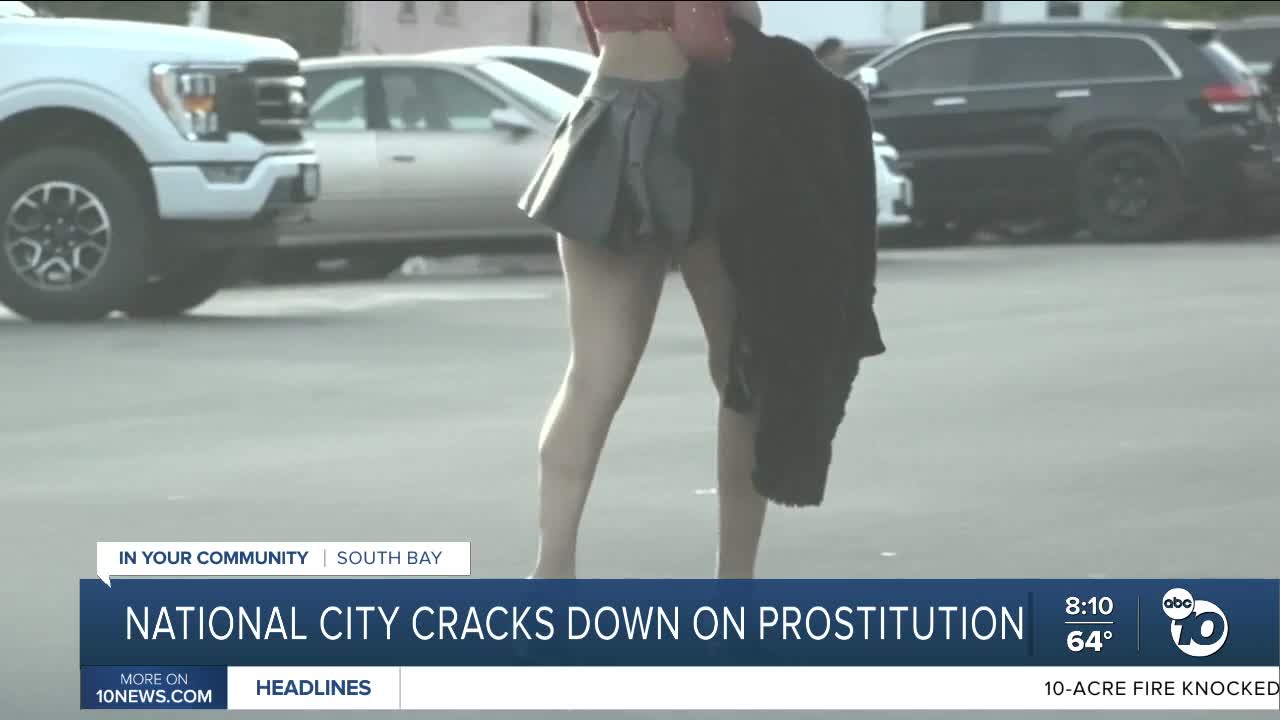


NATIONAL CITY (KGTV) — The National City Police Department just conducted another undercover operation to crack down on human trafficking and prostitution in the city.
The San Diego County District Attorney's Office said that human trafficking and prostitution are an $800 million industry in just San Diego County alone.
The push to get people off the streets comes as the District Attorney's office rolled out a new warning to anyone looking to pay for sex. Earlier this week, District Attorney Summer Stephan put up a billboard, paid for by asset forfeitures, that now overlooks Dalbergia Street in National City and Main Street in San Diego, warning that authorities know where the sex buyers are going and that more arrests are on the way.
This week, ABC 10News rode along with an undercover National City Police Detective to see how the department is working to make National City a safer place.
The National City Police Department targets pimps, sex buyers, and sex workers. While police work with District Attorney Summer Stephan's Human Trafficking Task Force, the task force does not arrest women. During ABC 10News' ride-along, National City police conducted an independent operation specifically targeting female sex workers.
At the intersection of 7th and Roosevelt Ave, ABC 10News watched an undercover officer make the first pickup as part of this operation.
The detective, who is not being identified because he often works undercover, directed his undercover 'Johns' to where the sex workers were positioned near 7th and Roosevelt Ave
"A lot of times they'll be standing either on the corner or actually like in the roadway in the intersection, and they'll be waving at cars, twerking, or they'll be dancing," the detective said.
The first woman who was arrested was heard over the wire to be offering the undercover officer oral sex for just $20.
"She ultimately didn't want to talk to me or provide me any information that would lead me to believe that she's a victim today, so she's going to jail and booked for prostitution," the detective said.
The detective said the typical going rate for oral sex is around $80, and full-service sex is around $120.
District Attorney Summer Stephan said a pimp's quota each night is to make $1,500. Stephan said pimps typically have about four women working the street at a time to try to reach that number.
That means at a minimum, each woman needs to find at least three to four people to have sex with a night.
The undercover detective said, "I think it's important from that perspective that we're getting these girls out of a situation where they otherwise wouldn't be able to get themselves out of, due to manipulation or force or fraud. But then also, this is a neighborhood, we have businesses, we have a school, we have families walking around, and families and children shouldn't be subjected to seeing scantily clad women walking through the street, it's just not appropriate."
The detective said National City is a part of a larger West Coast circuit for sex trafficking.
The women are moved around every week from Anaheim to Downtown Los Angeles, Las Vegas, and other cities. Every time they circle back to San Diego, the most popular stop is on the edge of San Diego and National City on Dalbergia Street, also known as "The Blade," a term that refers to any area where street prostitution happens.
Riding with the detective, ABC 10News drove through 'The Blade' multiple times and saw women, and even one pimp, get busted.
National City Mayor Ron Morrison explained how the city became a hub for prostitution.
"You've got to go back to the 60s and 70s," Morrison said. "We have the Mile of Cars now, but this area was called the Mile of Bars. You had a whole string of bars all up through here, and there was a lot of prostitution involving the Navy during the Vietnam War era."
In 2022, Morrison said prostitution increased after the Safer Streets for All Act made loitering for prostitution easier. The law was meant to prevent discriminatory arrests, but it backfired.
Stephan helped repeal that law, and since January, she has charged 151 pimps and sex buyers in just four months.
"So the overwhelming goal is to go after the people pulling the strings and the people who are the traffickers and the people who are lining the pockets of the traffickers who are the criminal buyers," Stephan said.
In the past three years, Stephan prosecuted 189 cases in the South Bay. Of those cases, 98 were in National City. Stephan said less than 10 percent of those cases were prosecuted of the women being trafficked.
"Our approach is not to prosecute this prostituted person, because we know no one grows up to say this is what I wanna do for a living to be sexually abused," Stephan said.
Stephan said the women who are being trafficked are sometimes as young as 12 to 13 years old, and detectives say the majority are in their 20s.
The undercover ride-along revealed a critical strategy: that arresting the women is a form of protection by separating them from their pimps.
The undercover detective said, "More often than not, these girls do have pimps that are forcing them to do this, coercing them to do this, and so we would like to take them out of that life."
Stephan added, "It's in order to help them accept services to begin the diversion and the services to extract them from this very dangerous life."
Detectives said they rotate undercover stings, going after pimps, buyers, and the women on different nights. They say operations where they're going after the women can often help lead them back to the pimps, as police are able to use the women's phones to trace their conversations with the pimps.
"A lot of that data is going to be on their phones, and we can't do that investigation without a proper, probable cause for a legal arrest," Stephan said.
Stephan said the goal of separating women from their pimps is to offer protection, shelter, and services to help them escape trafficking. She added that victim services staff, many of whom are survivors themselves, have shared similar testimonies with her in the 25 years she's been helping to combat human trafficking.
"They're the first ones to say I would have never had the courage to leave my trafficker because of fear, because of shame, because of trauma bonds if I didn't have that time where the police removed me from their observations through an arrest," Stephan said.
