

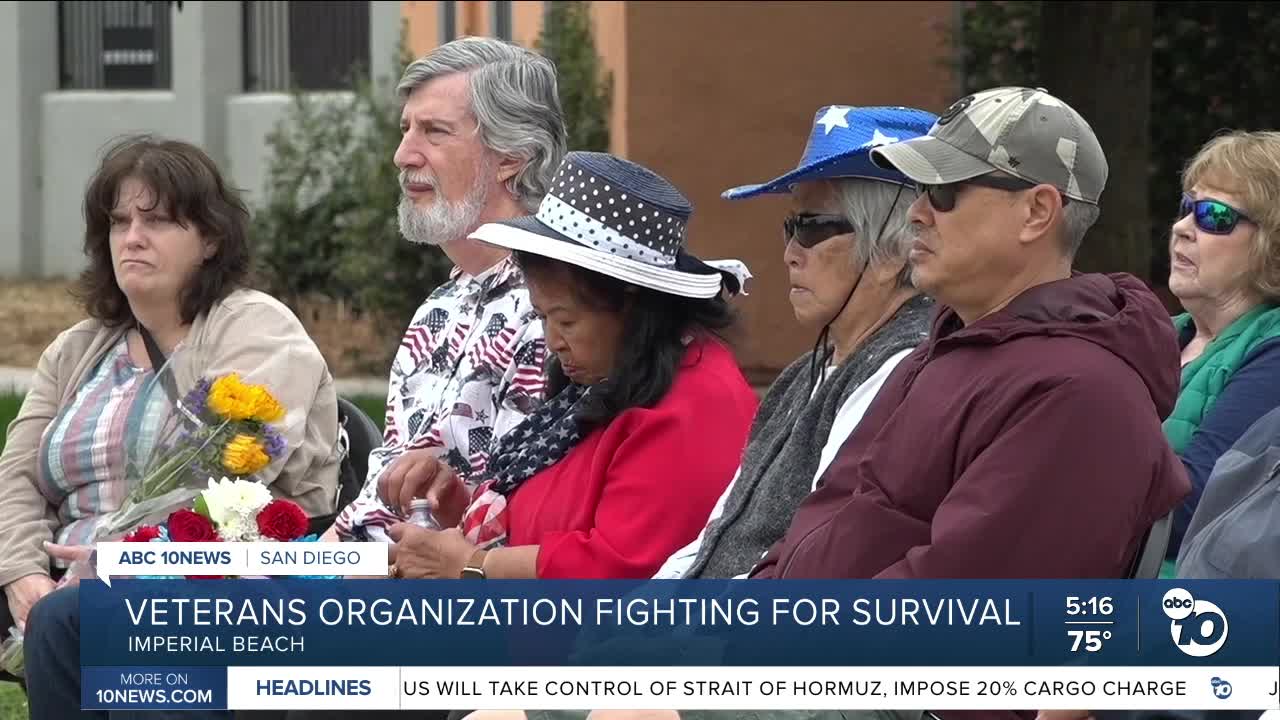


IMPERIAL BEACH (KGTV) — Active duty service members once came to places like the Fleet Reserve Association after work to unwind and find camaraderie with one another.
That's not the reality today, and a generational shift is threatening the future of veteran networks like FRA Branch 289 in Imperial Beach.
The branch just celebrated 63 years, but the milestone is also a reminder of how much has changed.
Mick Fulton, secretary of FRA Branch 289, has been with the branch since 1991. He says membership has fallen dramatically over the decades.
"When I joined, this branch was in the vicinity of 2000 members.
Currently, we're sitting at 409 members," Fulton said.
Mick says years of declining membership, driven by attrition and fewer younger service members joining, have put the FRA in a tough spot. He says the Navy's shift away from a drinking culture has also reinforced misconceptions about what the FRA is. But Mick says it's not about drinking—it's about camaraderie, advocacy, and providing financial support to service members and their families.
"I don't think it'll ever get back to the days when I first joined," Fulton said.
The Fleet Reserve Association is a congressionally chartered, non-profit organization designed to help Navy, Marine Corps, and Coast Guard members with various types of financial assistance. It relies on membership fees to provide those resources.
The branch has tried marketing, working with public information officers, community outreach, and pursuing royalties and corporate sponsorships, but those efforts have not been enough to reverse the trend.
Fulton is passionate about saving the FRA not just in Imperial Beach, but nationally. He points to the organization's advocacy work as proof of its lasting impact — including its role in establishing Tricare, the health care plan for military retirees.
"FRA was the driving force behind Tricare," Fulton said. "Convinced Congress that there needed to be a health plan for military retirees and that is basically how Tricare came about."
Without organizations like the FRA, the Veterans of Foreign Wars, or the American Legion, Fulton says there will be no one to go to Congress on behalf of service members.
"This is a family-oriented organization," Fulton said. "We're all about the cardinal principles of the FRA: we're loyal to each other, we protect each other and we provide a service to each other."
Mark Carrick, a volunteer morning cook and FRA member, says the organization is worth saving — even if younger service members are skeptical about joining.
"I felt that very same way. I'm not gonna connect with these 70 and 65 [year olds]," Carrick said.
But Carrick says the branch is the best place for gaining wisdom and finding support.
"It's like, no, you do not — don't quit, don't give up, stick it out," Carrick said.
"We do it because it's good for our soul," Carrick said.
The FRA conducts regular outreach in the community and on base, welcoming all service members. Family members, known as auxiliary members, are also welcome to join — even if their service member is no longer living.
Annual membership starts at $40. New members can get a special two-year membership for $64.
Auxiliary members start at $25 a year. Up to two generations can join, and if the member is deceased, they'll need to present a DD214 to prove that their family member served.
