

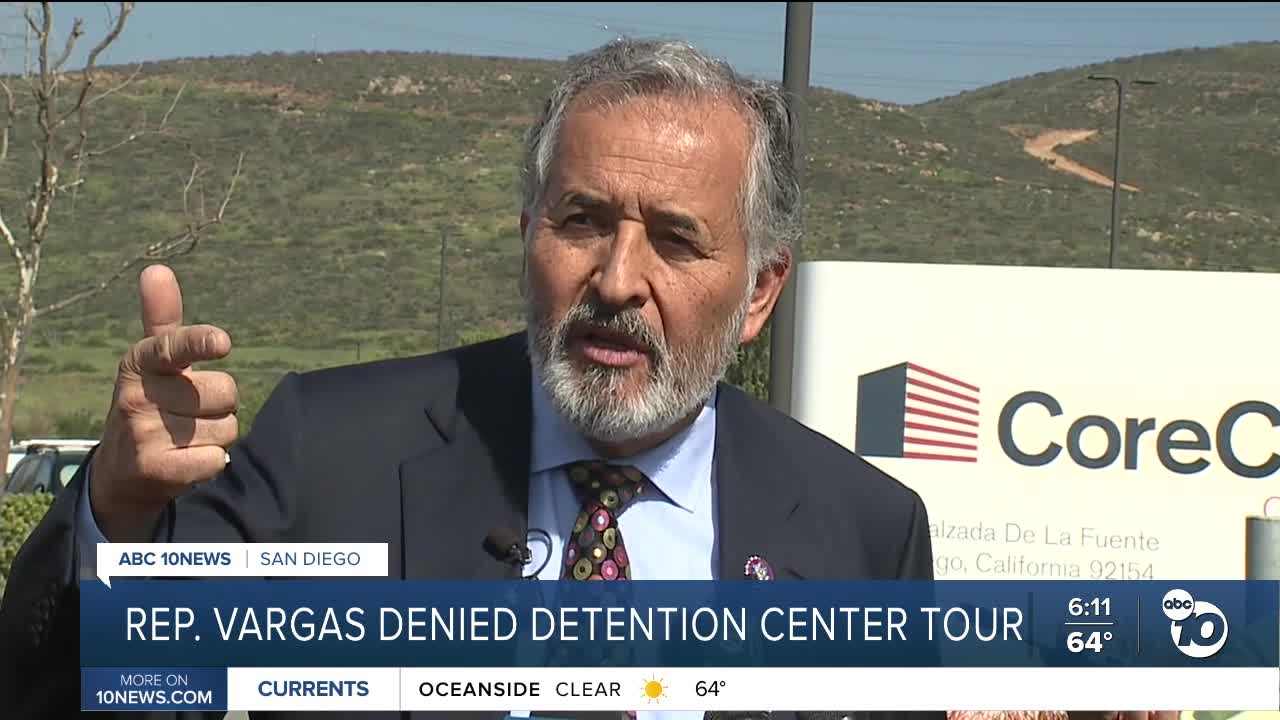


SAN DIEGO (KGTV) — Congressman Juan Vargas was turned away from the Otay Mesa Detention Center on Friday morning when he attempted to conduct an oversight visit after his office received reports of substandard conditions inside the facility.
The Democratic congressman said this was the first time he had ever been denied access to the detention center. According to Vargas, the warden told him the decision wasn't his own but rather a directive from Immigration and Customs Enforcement.
"I'm extremely disappointed, extremely disappointed," Vargas said after being turned away approximately 30 minutes after entering the facility.
Vargas said his office had received complaints about conditions inside the detention center, including allegations that detainees were not receiving fresh food, were constantly getting sick, and were being held in cold conditions.
"I don't know if the food is food that's edible. I don't know that. I don't know if the conditions that they're holding people in there are standard or substandard. I don't know that," Vargas said.
The congressman was provided with a written memo dated January 8th stating that facility visits must be scheduled a minimum of 7 days in advance. However, Vargas strongly disagreed with this policy, citing a judge's order issued earlier this week requiring unannounced congressional visits to be accommodated.
The court ruling currently applies only to 13 Democratic members of Congress named in a related lawsuit.
"We have every right to be here. That's the whole point. You have every right to be here, and I've done this many times before, and I have to tell you, each and every time they've allowed me in," Vargas said.
The congressman said he is considering taking legal action to gain access to the facility.
ICE did not respond to requests for comment. CoreCivic, which operates the facility, sent a lengthy statement saying claims of food quality issues at the facility are false and that the safety, health and well-being of individuals in their care is their top priority.
You can read CoreCivic's full statement here:
"The safety, health and well-being of the individuals entrusted to our care is our top priority. We take seriously our responsibility to adhere to all applicable federal detention standards in our ICE-contracted facilities, including our Otay Mesa Detention Center (OMDC).
It is important to know that any claim of food quality issues at OMDC is patently false. We provide three nutritious meals a day for those in our care. We take great care to offer meals that support specialized diets, including religious diets and more than a dozen therapeutic diets, as well as cultural preferences. Menus are reviewed and approved on a regular basis by a registered dietitian to ensure appropriate nutrition is provided. This menu review includes the common fare diet and religious diets, including food portions and nutritional content. Staff at the facility routinely eat the same meals as those served to the detainees.
As we have shared previously, it's important to note that the term "solitary confinement" is often incorrectly used by the media, activist groups, and others. Solitary confinement, whether as a term or in practice, does not exist at OMDC, or any facility that CoreCivic operates. We have restrictive housing units (RHU) at OMDC that are provided for various reasons, including medical and mental health observation and administrative/investigative purposes. RHU is not used in any way as a form of disciplinary action. It's also important to note that detainees themselves can and do request protective custody.
Our immigration facilities are monitored very closely by our government partners at ICE, and they are required to undergo regular review and audit processes to ensure an appropriate standard of living and care for all detainees. As we have shared in our previous responses, all our immigration facilities operate with a significant amount of oversight and accountability, including being monitored by ICE officials on a daily basis. We also have our own detailed Human Rights Policy [corecivic.com] that clearly outlines our commitments regarding detainee rights and treatment, including legal rights, safety and security, healthcare, visitation and standards of living.
CoreCivic plays a limited but important role in America’s immigration system. We have a long-standing, zero-tolerance policy not to advocate for or against any legislation that serves as the basis for – or determines the duration of – an individual’s detention. CoreCivic does not enforce immigration laws, arrest anyone who may be in violation of immigration laws, or have any say whatsoever in an individual’s deportation or release. CoreCivic also does not know the circumstances of individuals when they are placed in our facilities. Those matters are at the sole discretion of the federal government. Our responsibility is to care for each person respectfully and humanely while they receive the legal due process that they are entitled to.
We have a robust grievance process available to all detainees that provides multiple safe and discrete avenues for concerns to be raised, including toll-free telephone numbers. All detainees also have access to management staff. Most detainee complaints are processed through ICE's ERO Detention, Removals and Information Line. For more information, click here [ice.gov]."
This story was reported on-air by a journalist and has been converted to this platform with the assistance of AI. Our editorial team verifies all reporting on all platforms for fairness and accuracy.
