

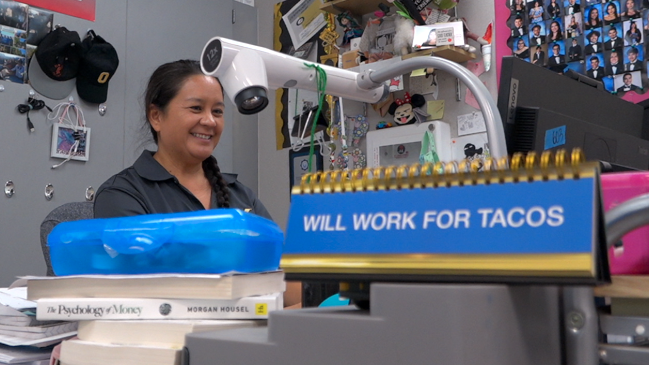


CHULA VISTA, Calif. (KGTV) — Next year, California will require personal finance education for high school students as a graduation requirement, but one Chula Vista teacher is already ahead of the curve, teaching teenagers how to manage their money.
Allison Saiki, a teacher at Olympian High School, has taught in the Sweetwater Union High School District for 19 years. She began teaching financial literacy last year after spending years developing a course she believed students needed.
Under AB 2927, California will require all high school students to complete a semester-long personal finance course to graduate, and for Saiki, it's validation.
“And now I have California behind me to say, yes, we do need this for our kids,” Saiki said.
Saiki made it her mission to develop a curriculum for financial literacy back in 2019, when she was teaching financial algebra.
“I saw the real applicability of mathematics in real life,” Saiki said. “I thought to myself, why isn’t everybody learning this?”
She began researching financial literacy programs and came across Next Gen Personal Finance (NGPF). She soon became certified to teach the subject and helped develop a curriculum. In 2023, she pitched the course to the school's principal.
After years of work, the financial literacy class was launched at Olympian in 2025.
Saiki is now the only teacher in the Sweetwater District teaching financial literacy and one of a handful of teachers in San Diego County doing so.
“All students need this. They need the access. Money is universal,” Saiki said.
Saiki’s financial literacy lessons cover practical skills such as budgeting, taxes, checking accounts and understanding income. She shared her outline, and it is as follows:
- How do we value and respect money?
- How do we earn money?
- Where do we put our money?
- How do we grow our money?
- How do we pay what we owe?
- How do we protect what we've built?
- How do we put it all into action?
In one class ABC 10News visited, she also challenged students to think about the skills they believe are important in the workplace.
“A lot of jobs involve communicating with people, but [with] some jobs, it's more important to communicate with people than other jobs are,” student Ian Traxler said.
The course also asks students to examine their own attitudes and biases about money and how those beliefs can affect their financial decisions.
Student Enrique Preciado said the class has made him think more about how he handles money.
“I want to be financially responsible,” Preciado said. "Some cognitive biases that we've learned [about], some are negative, and some are positives and I probably could improve on that, especially when it comes to my money and how I handle it."
Saiki said one of her favorite parts of teaching the course is introducing students to financial tools they may not otherwise learn about in school.
“I get to teach them new things like high-yield savings accounts and Roth IRAs, and I want them to really question the social media posts that are out there, like what people are telling them to buy because the stock is going to go crazy,” Saiki said. “I’m hoping I can get them to think critically, and I'm hoping they can make a lot of money in the future."
