

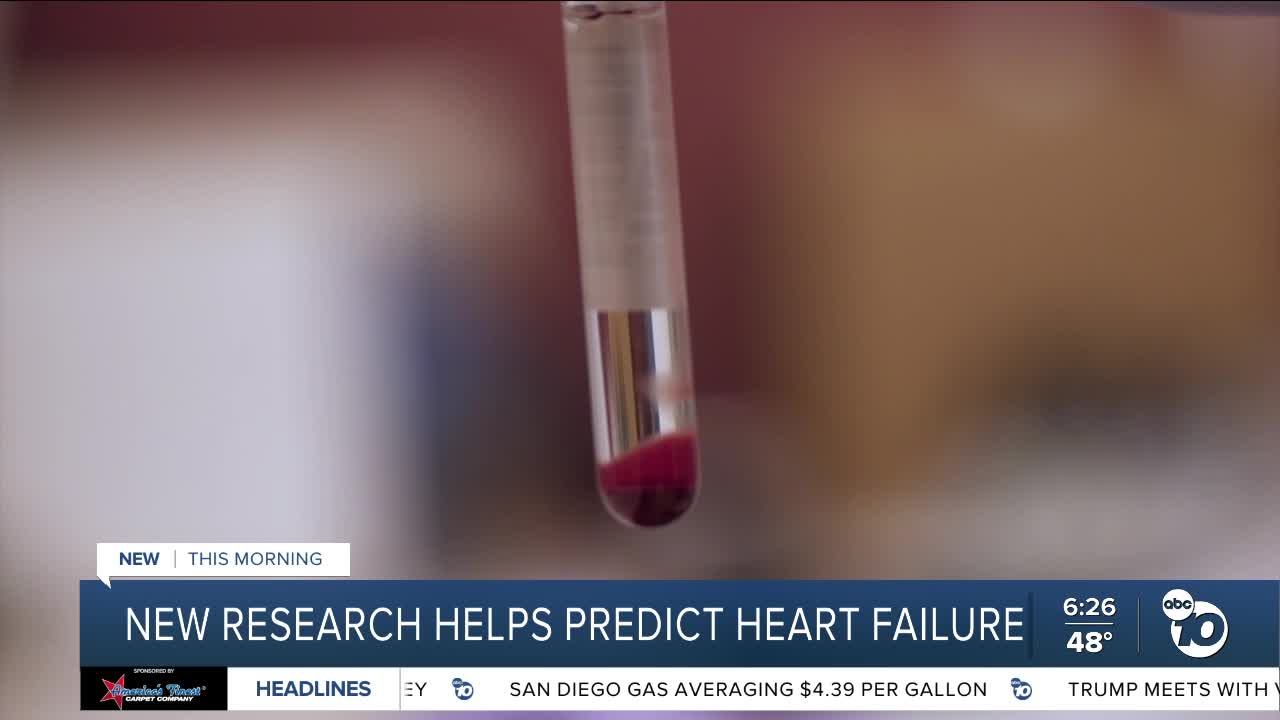


LA JOLLA, Calif. (KGTV) - New research from UC San Diego Health shows a basic blood test may help doctors identify signs of a serious heart condition before it becomes life-threatening.
The study, published in the journal Nature Medicine last week, demonstrates how a simple blood test can detect signs of pulmonary arterial hypertension. This condition occurs when blood cells with a receptor called "Notch3" become clogged in the lungs and can eventually lead to heart failure.
"Pulmonary hypertension, with the backup of blood in the lung from these clogged blood vessels, ultimately puts a patient into right heart failure," said Dr. Patricia Thistlethwaite from UC San Diego Health, who led the research.
When it's activated, the Notch3 receptor has one specific piece that a test can identify in the blood. That lets doctors determine not only if the condition is present but also how severe the problem has become.
"This has been a holy grail in the field — a simple blood biomarker that could tell us you have the disease, and yes, it's getting worse. (It) would be a great advance compared to the multiple combinations of tests, some of them invasive, that are used to diagnose this disease," Dr. Thistlethwaite said.
The test works from a simple blood draw requiring just 5 cc of blood. The study followed approximately 700 people to develop and validate the blood test approach.
Beyond early detection, the test could help doctors monitor disease progression and adjust treatments accordingly.
"Our hope is, that with this marker, we can both diagnose the disease earlier and then be on top of (a patient's) markers going up. Now we'd need to switch their drug regimen, for example, like to move to something more advanced or more potent," Dr. Thistlethwaite said.
The breakthrough didn't surprise Dr. Thistlethwaite, who has been researching this pathway for years.
"I've been studying the notch three pathway for over a decade at this point in my basic science lab. So it was something that was always in the back of my mind, that could exist as a biomarker. This technology of being able to detect it in the blood at low amounts has opened the door for us to really make this something of clinical utility," she said.
Dr. Thistlethwaite said the next steps involve conducting a larger study to determine if this method works effectively across all age groups and how it compares to diagnostic approaches for other lung diseases.
Currently, diagnosing pulmonary arterial hypertension often requires multiple tests, some of which are invasive procedures. This new blood test could potentially streamline the diagnostic process and help doctors catch the condition earlier.
This story was reported on-air by a journalist and has been converted to this platform with the assistance of AI. Our editorial team verifies all reporting on all platforms for fairness and accuracy.
