



LA JOLLA, Calif (KGTV) — For years, patients with a dangerous leaky heart valve faced a grim reality: If they were too sick for open heart surgery, there was nothing doctors could do.
Now, that's changed. And Scripps Memorial Hospital played a big role in this "game-changing" medical breakthrough.
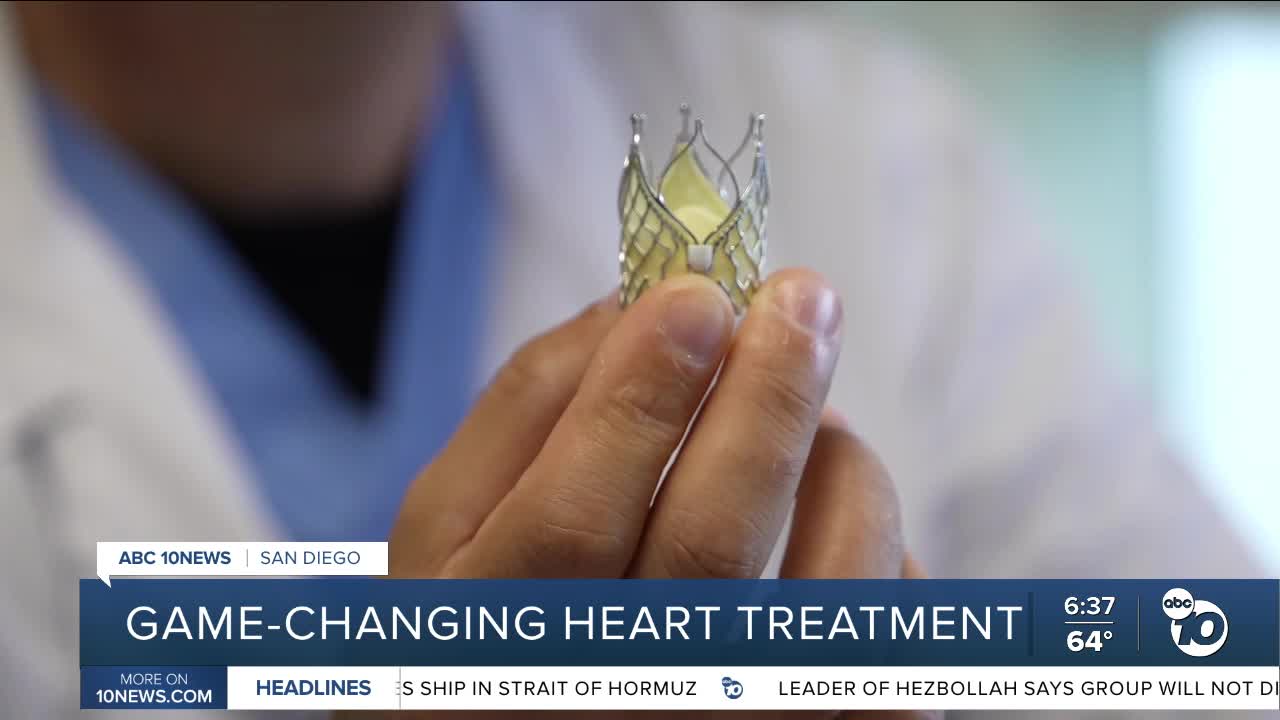
A new device called the JenaValve Trilogy has received full FDA approval to treat severe aortic regurgitation — a condition where the valve between the lower left heart chamber and the body's main artery doesn't close properly. That lets blood flow the wrong way. Over time, that forces the heart to work harder and harder, causing fatigue, shortness of breath, chest pain, lightheadedness, swelling in the ankles and feet, and an irregular heartbeat. Left untreated, it can lead to heart failure and death.
Scripps Clinic cardiologist Curtiss Stinis, M.D., helped make the approval happen. He served as lead investigator at Scripps for the clinical trial that validated the device — and on April 21, he became the first doctor in San Diego County to implant it in a patient following FDA clearance.
"This is life-changing, for the right patient. Without a doubt," Stinis said.
How the device works
Previous TAVR devices were designed to treat valves narrowed by calcium buildup — a condition known as aortic stenosis — and rely on those calcium deposits to anchor in place. That made them a poor option for aortic regurgitation patients, who typically lack those deposits.
The Trilogy can anchor to the valve even without calcium present.
"This was designed differently," Stinis said. "It has three portions on it called 'locators,' and those actually locate and grab on to or grasp on to the existing doors or leaflets of the valve. And that allows this to anchor when there's no calcium present."
The procedure takes about an hour, and the device is fed through the patient's groin, up the femoral artery and into the beating heart, where it is opened and anchored in place.
"That's kind of the magic trick of this whole thing," Stinis said. "This device is essentially like a giant spring. It can be compressed down into a much smaller tube, and that's inserted through an artery in the groin."
Most patients go home the following morning.
Trial results
Scripps Clinic cardiologists and 22 of their patients participated in the pivotal clinical trial. Results were published in the medical journal The Lancet in November.
Of nearly 700 participants nationwide — almost all of whom entered the trial with moderate-to-severe aortic regurgitation — only 3 ended up with any significant residual valve leakage following their procedures. Stroke rates and mortality were also significantly lower in study participants after one month of treatment than would have been expected had they undergone open-heart surgery. Researchers also found that patients had significant improvement in function and quality of life for up to two years following treatment.
"It's a serious game changer. These people have no other option for treatment, and they were slowly declining, and they would pass away from this condition," Stinis said.
Aortic regurgitation is the third most common heart valve disease, according to a 2022 study published in the peer-reviewed medical journal Open Heart. About 4% of Americans over 75 have the condition, and its prevalence has increased as the U.S. population has grown older.
One patient's story
For John Rufo of Escondido, the Trilogy valve has been a lifesaver.
The 65-year-old engineer and business developer was diagnosed with aortic regurgitation in late 2023 after a routine echocardiogram. His symptoms worsened, and his overworked heart began to grow — a sign of heart failure. A device implanted 12 years earlier during open-heart surgery for an unrelated heart problem made another surgery too risky.
Stinis enrolled Rufo in the Trilogy clinical trial and implanted the device in May 2024 during an outpatient procedure. Rufo felt better almost immediately.
"The next day!" Rufo said, when asked how quickly he noticed a difference.
"Before my surgery, I couldn't even chase my wife. Now I can catch her," he added.
His heart soon returned to its normal size.
"Without a doubt, the TAVR device saved my life," Rufo said.
Now, nearly two years later, Rufo is back to his old life — enjoying trips to the lake and time with his family. His daughter is getting married this summer, and he plans to be on the dance floor.
"Something like this totally changes your perspective. You think you're going to die, you know you're on a ticking time, I mean, you just wanna be with the people you love," Rufo said.
"I'm going to dance with my daughter, be there with my family, and I can't think of anything more wonderful," Rufo said.
What's next
Stinis said the next step in the research would be to determine whether the Trilogy device could be a better option for all patients with aortic regurgitation — not just those who cannot undergo open-heart surgery.
This story was reported on-air by a journalist and has been converted to this platform with the assistance of AI. Our editorial team verifies all reporting on all platforms for fairness and accuracy.
