

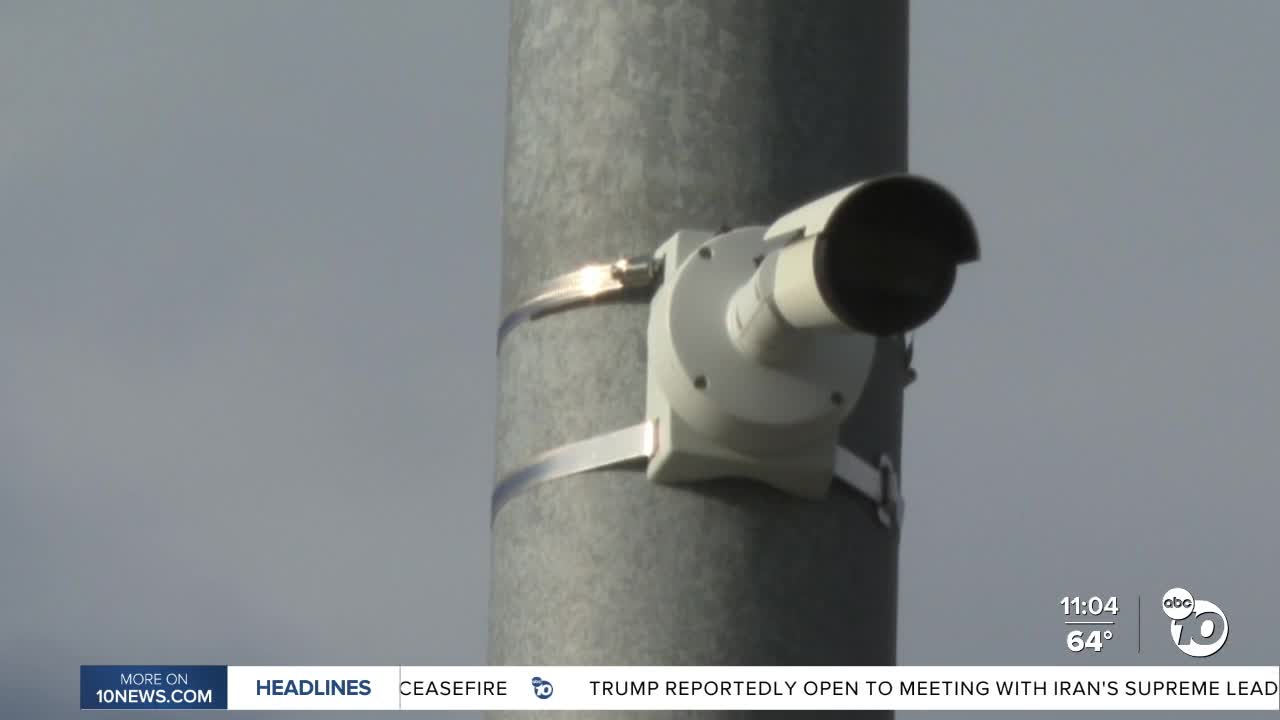


SANTEE (KGTV) — The City of Santee is moving closer to deciding whether to install automated license plate readers (ALPRs) as part of a pilot program aimed at helping law enforcement investigate crimes and recover stolen vehicles.
City leaders say the technology would provide another tool for deputies to improve public safety, but the proposal comes as concerns over privacy and data collection continue to spark debate across California.
Under the proposed agreement with the San Diego County Sheriff's Office, six cameras would be installed at key locations throughout Santee as part of a one-year pilot program.
"What we expect is that it's gonna help us quite a bit in Santee," said Santee Mayor John Minto.
The cameras are not designed to issue speeding tickets or collect tolls. Instead, they capture license plate information that investigators can use to track stolen vehicles, locate suspects or gather evidence in criminal investigations.
City leaders say the pilot would allow officials to evaluate the system's effectiveness before deciding whether additional cameras are needed or if the program should become permanent.
"Once we do that and we see how that program goes, then we'll bring it back again and see if we have to include any more cameras, or maybe we can find better or more strategic places to put those," Minto said.
Santee would join a growing number of cities across San Diego County that have adopted or expanded the use of ALPR technology in recent years.
However, privacy advocates have raised concerns about how the data is collected, stored and shared. Those concerns were highlighted recently in neighboring El Cajon, where California Attorney General Rob Bonta took legal action against the city over the sharing of data collected through license plate reader cameras.
Despite those concerns, Minto says the goal in Santee is straightforward.
"This is absolutely about keeping the public safe," he said. "The more tools that our law enforcement agencies have, the better they can do."
Minto also expressed confidence that safeguards are in place to protect residents' information, pointing to state regulations governing how ALPR data can be used.
"I'm very confident about the information of individuals not being shared, and the reason why is because of Senate Bill 34," Minto said. "It's very clear. The follow-up by the Attorney General is very clear."
In a statement to ABC 10News, Captain Chris Katra of the San Diego County Sheriff's Office Santee Station said privacy protections surrounding the technology are strictly regulated.
"The privacy safeguards surrounding ALPRs are highly regulated by state law and our own internal Sheriff's policies that exceed state law requirements," Katra said. "Additionally, private citizens/business can purchase this same technology."
If approved, the program would operate for one year before city leaders determine whether to continue, expand, or discontinue its use.
The proposed agreement is expected to return to the Santee City Council for review at a future meeting before a final decision is made on the pilot program.
