

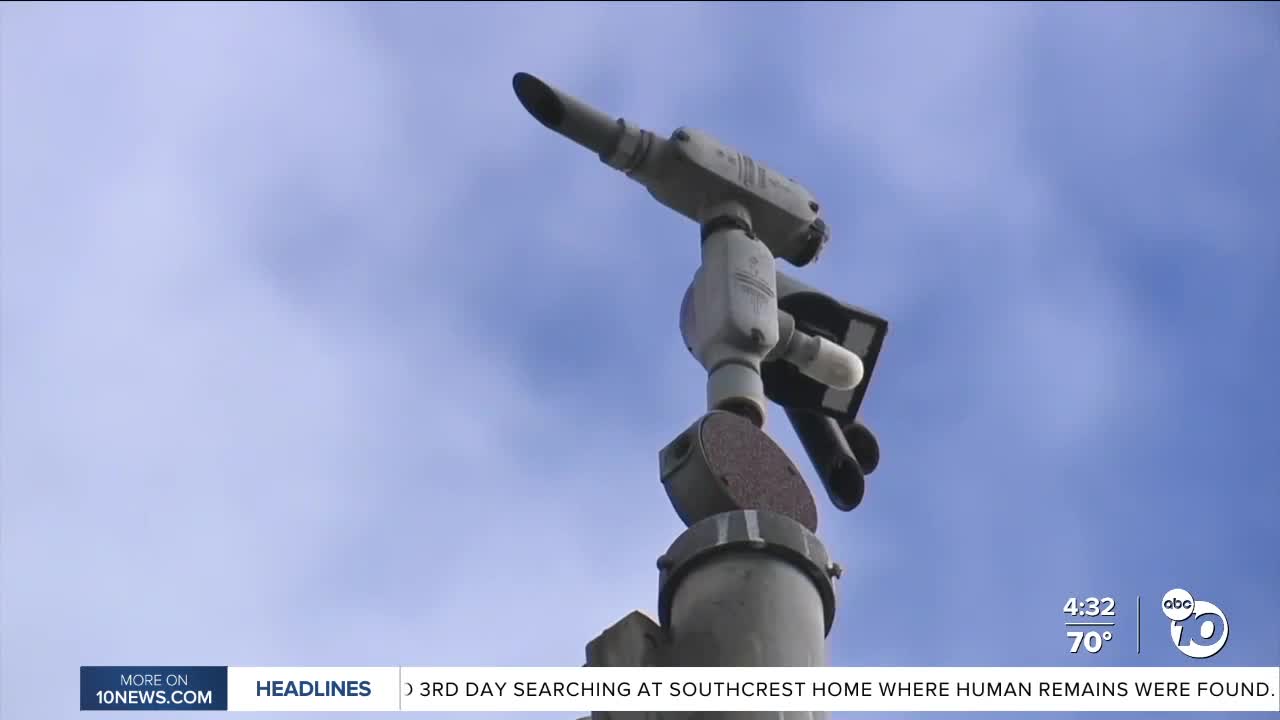


SAN DIEGO (KGTV) — Trust SD, a coalition of 60 nonprofit organizations, gathered outside San Diego's Civic Center Plaza on Thursday to demand that the city eliminate its Flock automated license plate reader (ALPR) camera system, citing privacy breaches and data misuse concerns.
The protest comes just days before the San Diego City Council considers a resolution to maintain all police surveillance technologies, including the San Diego Police Department's use of Flock cameras.
Councilmember Henry Foster III raised concerns about data security breaches during the demonstration.
"Here in San Diego, we learned that our ALPR database was left open to outside agencies. This access led to thousands of searches by non-local law enforcement," Foster said.
San Diego began installing hundreds of automated license plate reader cameras in late 2023.
A map of the camera's locations can be viewed here.
Community members now allege the technology has been used to target immigrants, even women seeking reproductive care.
"We had a worker who was literally dragged across a parking lot and thrown into an unmarked car," Bridgette Browning, President of the San Diego and Imperial Counties Labor Unions said.
Another demonstrator, Homayra Yusufi, raised concerns about women's safety.
"I don't think any woman is safe here. We've seen multiple cases in which women who have sought reproductive care have been tracked by the Flock system," Yusufi said.
Despite the criticism, the San Diego Police Department reports significant success with the camera system.
The department says Flock cameras have assisted in 600 investigations, led to the recovery of over $6 million in stolen property, resulted in 450 arrests, helped recover more than 460 stolen vehicles, and contributed to a more than 20% drop in motor vehicle theft and car prowls.
Councilmember Raul Campillo defended the technology's effectiveness and cost efficiency.
"The public is getting a very good deal with this technology," Campillo said.
Campillo noted the program costs roughly $2 to $3 million annually to operate, which he considers cost-effective given the police department's staffing challenges.
"It's cost-efficient, roughly $2 to $3 million a year to run this program. When our police department is actually about 1,000 police officers short of what it would need to meet the essential ratio that other big cities have of police officers to citizens," Campillo said.
Campillo also disputed Foster's privacy breach claims, citing California's protective laws and contractual safeguards.
"Our own contract prevents our police department from taking any of our information and using it for other states, the federal government has to go get a subpoena from a court," Campillo said.
The City Council will vote on the resolution regarding surveillance technology next Tuesday at 2 p.m.
