

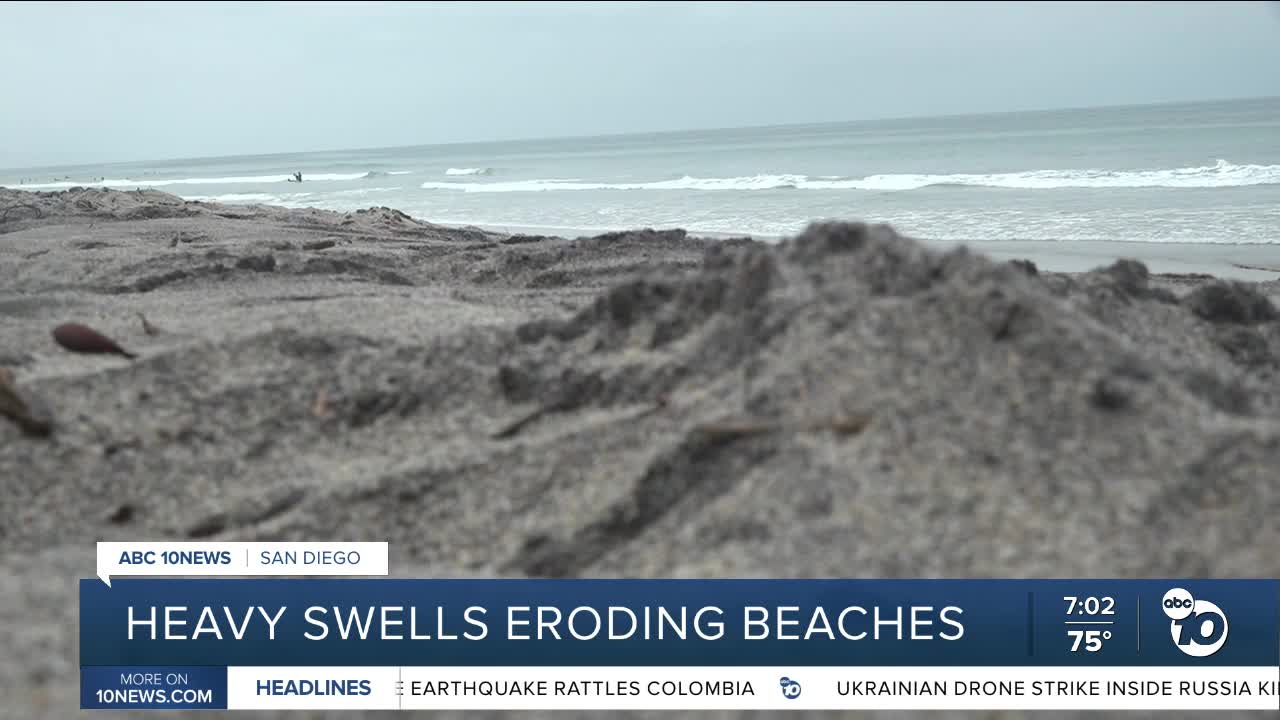


CARLSBAD, Calif. (KGTV) - Strong swells and high tides have eroded significant portions of sand from a North County beach in recent weeks, prompting lifeguard tower relocations, parking lot closures, and concerns from beachgoers.
In Carlsbad, the erosion has been most dramatic at Tamarack State Beach. In a span of a few weeks, the popular surf spot has lost much of its sand, turning into a rocky shoreline. Lifeguard towers have been relocated and 35 parking spots have been blocked off.
Madelyn Morgan, visiting from Huntington Beach, said the scene was not what she expected.
"Definitely sad to see," Morgan said. "Does take away a little. I’m glad to be sitting on the rocks, but, of course, I would love to be on the sand.”
State Parks officials say they will work with coastal engineers to help keep the parking lot open. The beach has undergone several sand replenishment projects, including one in 2025.
Along Moonlight State Beach in Encinitas, Buenas Olas Surf School co-owner Naiara Morales is working with less beach space than she had just a few months ago.
"Probably started with about 40 feet of beach space. It's about a third or a half down now," Morales said.
Lifeguards I talked to have also noticed the retreating beach.
Morales says she noticed the erosion began in early June, driven by high tides and heavy swells, some caused by Hurricane Genevieve.
In Encinitas, an ongoing replenishment project that began a few years ago will add sand about every 5 years. Morales points out natural sand return is also expected heading into winter.
In a statement, a spokeperson with the City of Encinitas disputed the amount of sand stripped away by the strong swells.
"Beach sand shifts in cycles, typically following the seasons of the year and the storm events and/or wave action that occur. Typically moving north in the Summer and Fall months with the southwest and south-southwest wave direction and south in the Winter and Spring months with the northwesterly angled swells. Sand moves within a Littoral Cell or a self-contained coastal compartment along the longshore transport. In our case, we have the Oceanside Littoral Cell that is bound by Dana Point Harbor to the north in Orange County and the La Jolla Trench to the south in San Diego City. This includes many jurisdictions (Dana Point, San Clemente, County of Orange, Camp Pendleton, Oceanside, Carlsbad, Encinitas, Solana Beach, Del Mar and San Diego). In Summer and Fall we experience “more” sand placement on the beach. During this cycle, the wave action naturally brings sand back to the back beach from the near shore. This summer with the past Hurricanes of Fausto and Genevieve, more sand was displaced in the immediate area due to intense wave action and storm surge. Once the storms subsided, the sand naturally (and very slowly) moves back onto the beach and the back shore through wave action and tide cycles, either to the north or south, based on the typical seasons.
The City of Encinitas beaches have fared very well through this summer. We lost some sand during those Hurricane events, but not 1/3 of the overall mass. South Orange County beaches were hit much harder. Our beach profiles from Beacons Beach south, look very good. We added three beach nourishment projects to our six-mile reach of coastline this year, including 6,000 cubic yards at Batiquitos State Beach (behind the Alila Marea Beach Resort and SeaBluffe Condominiums), 9,000 cubic yards to the Beacons Beach area known as Leucadia State Beach, and 23,000 cubic yards to the Cardiff State Beach area. Overall, the City of Encinitas Coastal Zone Management Program has been very successful."
This story was reported on-air by a journalist and has been converted to this platform with the assistance of AI. Our editorial team verifies all reporting on all platforms for fairness and accuracy.
