

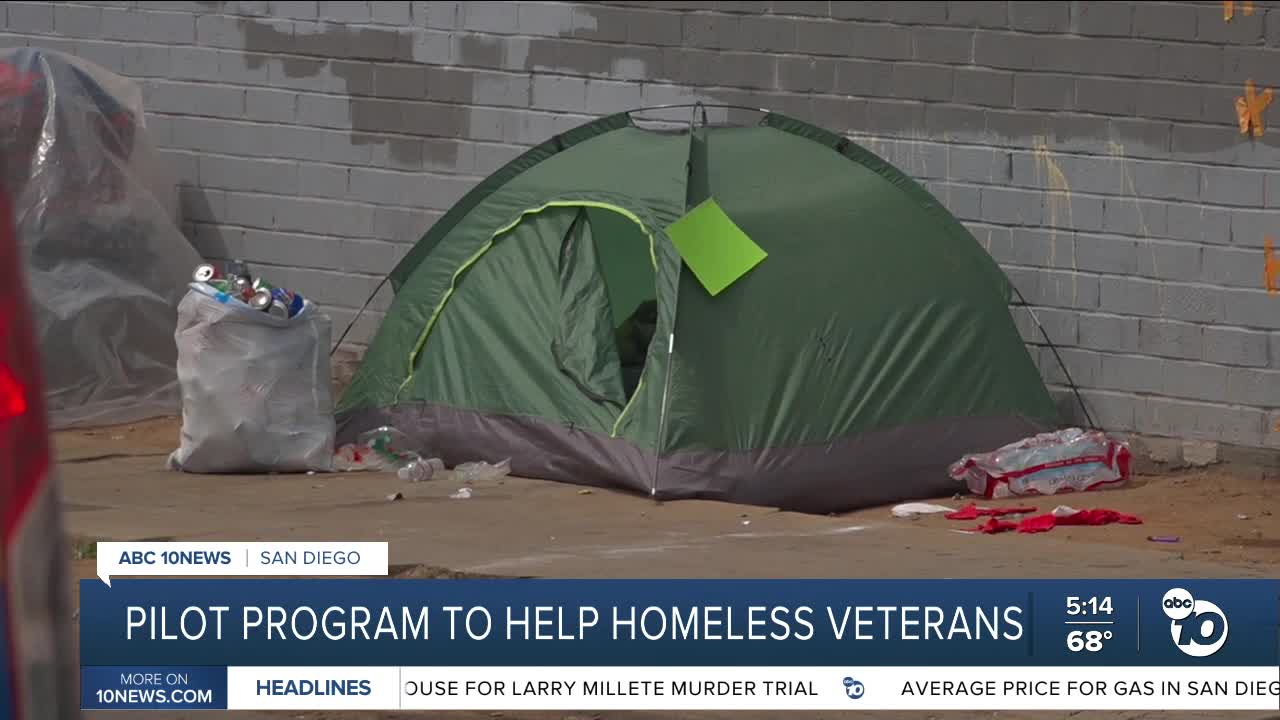


SAN DIEGO (KGTV) – There’s a new pilot program organized by the Regional Taskforce on San Diego and the Lucky Duck Foundation that’s aiming to help our homeless veterans.
Not knowing where to go can be an unsettling feeling.
“If the organization, the foundation that’s not paying him, wouldn’t afford him the availability to us, I’d literally be lost,” Damien Carlisle, a homeless U.S. Navy veteran, said.
Carlisle knows that all too well.
“I found myself homeless January 5th, the day after my birthday this year. Totally unexpected, I stayed in a hotel room for a week-ish,” Carlisle said. “And grace of God, I was able to come here to VVSD (Veterans Village of San Diego) January 13th of this year.”
Those at the shelter can get legal help from Chris Czaplak.
“They hear VA disability, and they think they, you know, they had to have lost a limb in combat, and that's just not the case. And so some of them have never even applied before and they don't even know what's available to them,” Chris Czaplak, Managing Partner of Home Front Group
It’s thanks to a new pilot program from the Regional Taskforce on Homeless San Diego and the Lucky Duck Foundation.
“To help veterans in homelessness by connecting to their long-term benefits that would permanently end their homelessness once and for all,” Drew Moser, CEO of The Lucky Duck Foundation
Czaplak’s firm specializes in getting veterans their disability benefits.
He was hired in February to run the free legal aid pilot program to help the vets at VVSD.
“If we can help them unlock their veterans' benefits, get their ratings increased, get them ratings period, get their discharges cleaned up, we could get them on a path to sustainable housing, healthcare, education, job retraining, and get them back to being productive citizens, which is what they want to be,” Czaplak said.
Part of that is helping those like Carlisle navigate the grey area of “other than honorable discharges” from the military.
“There was a minor misconduct, and through whatever the circumstances are, they end up with an other than honorable discharge. That's not a hard no, but oftentimes the first response from the VA is you are barred from receiving benefits,” Czaplak said. “Those are the hardest cases.”
Carlisle told ABC 10News he got into a serious car accident, leaving his base nearly 30 years ago in 1995, that resulted in a traumatic brain injury.
Czaplak said the injury contributed to some poor choices, which led to other-than-honorable discharge.
But, since working with Czaplak since February, he’s now able to receive VA benefits.
“At 51 years old, 31 years post-discharge. I actually can see a future worth having. And so, in its own, weird kind of way, VVSD has been the best thing that happened to me,” Carlisle said.
It’s a program that Czaplak told ABC 10News hopes one day could expand.
“I’m helping these guys get, you know, get their life on track and, I see hope in their eyes and it's been a long time,” Czaplak said.
