

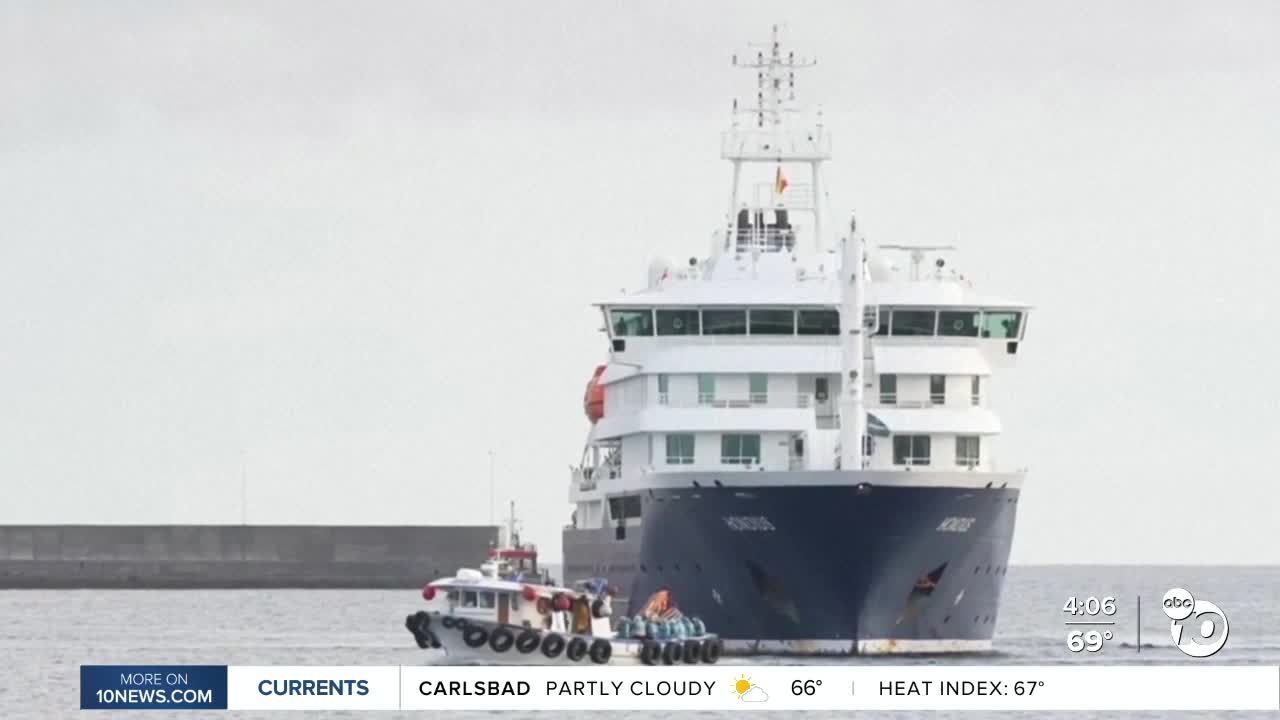


SAN DIEGO (KGTV) – The total number of confirmed and probable cases of hantavirus among those who were onboard the MV Hondius cruise ship has risen to 11.
At least two people have died from the virus. This week, 16 American passengers who were on board the ship arrived at the University of Nebraska Medical Center.
They're being monitored in a quarantine unit.
It all began with an infectious disease involving people on a cruise ship.
It's not the first time the world has heard that, and it sounds very familiar to COVID.
“There's a lot of PTSD for all of us. It has a lot of reminiscing of cruise ships and viruses breaking out in distant places, and it seems like it's coming closer and closer to home. So, I get it,” Dr. Davey Smith of UC San Diego Health said.
Smith is an infectious disease expert from UC San Diego.
He told ABC 10News that while the hantavirus is serious, he believes it’s not something that could be a COVID-level event.
“The main thing here is that this virus is very different. We've known about this virus for a long time. It does look to be a little more infectious than we thought it was ever in the past,” Smith said. “That's a little concerning. But still, it's not as infectious as COVID, and I am not worried that it's going to be the next pandemic.”
Smith says current estimates show up to 40 percent of people who get the virus could die, and we don’t have a treatment for it.
He recently got back from Washington, D.C., after a meeting with the National Institute of Health about responding to infectious diseases, where the hantavirus came up in conversation.
“Basically, on how do we become better prepared for these viral outbreaks and how do we develop therapies for this so right now hantavirus does not have a therapy,” Smith said. “And there are some investigational products, what we call, you know, experimental drugs basically, that could potentially work for hantavirus, and could we actually use these right now for the people who have the infection?"
Smith says there’s already really good planning happening with the Centers for Disease Control and Prevention for containing the virus.
“What has been lost, though, is we don't have the connections like we used to have with the WHO (World Health Organization) so that we could coordinate such efforts,” Smith said. “It’s multiple different nationalities were on that ship, and they're going home to different places, and how do we coordinate that has kind of been lost, and that's sad.”
San Diego County told ABC 10News they haven't heard from the state Department of Public Health that any returning Californians on the cruise ship at the center of the virus are San Diegans.
