

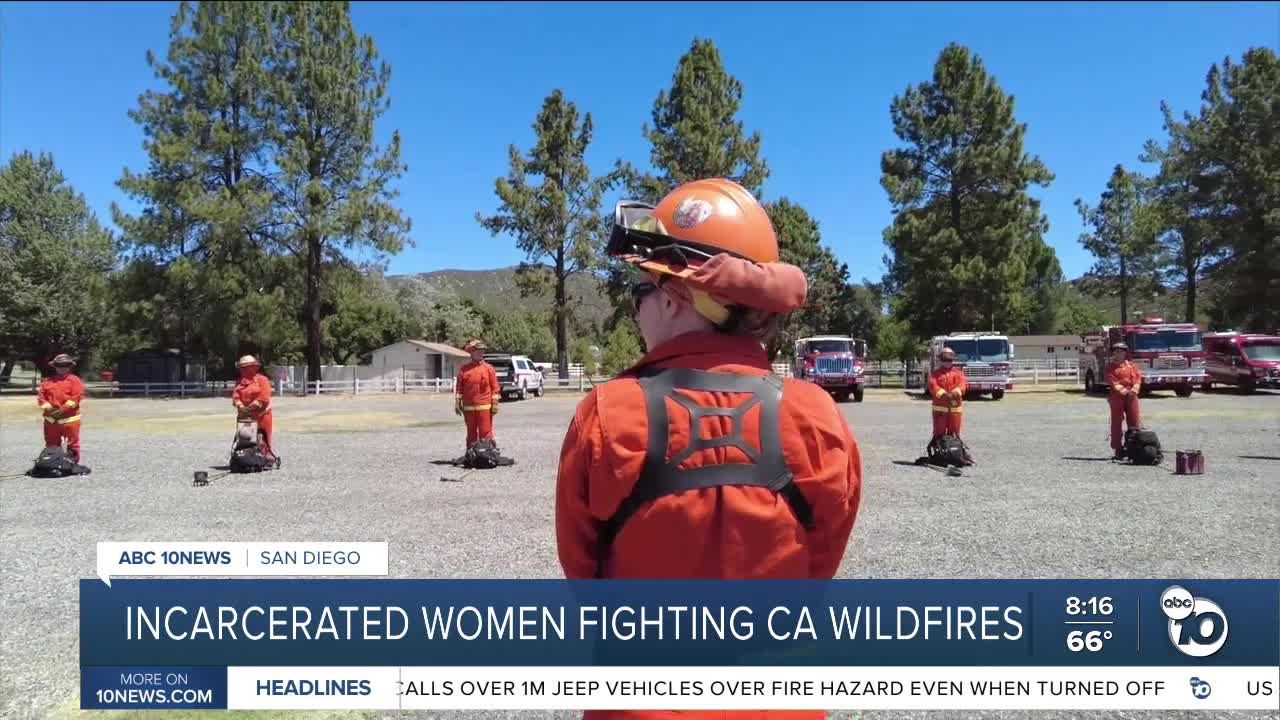


WARNER SPRINGS, Calif. (KGTV) — At Puerta La Cruz Conservation Camp in Warner Springs, 33 incarcerated women form two hand crew teams on the front lines of California's wildfire season — volunteering to risk their lives not just to serve their time, but to serve their community.
The women are part of a joint program between CAL FIRE and the California Department of Corrections and Rehabilitation (CDCR). Puerta La Cruz is one of two conservation camps in the entire state - the other being in Malibu - to train incarcerated women to fight wildfires.
California faces nearly 8,000 wildfires every year, and CAL FIRE depends on hand crews to fight them. Nearly half of those crews are made up of incarcerated men and women.
CDCR reported that as of April 2026, there are approximately 1,920 incarcerated people working at fire camps.
The camp recently completed its annual fire preparedness exercise, which includes a drill known as a tool out — where fire gear is inspected and fire knowledge is tested — followed by a one-hour hike, a fire shelter drill, and one hour of fire line construction.

CDCR said the firefighters may work 24-hour shifts from 7 a.m. to 7 a.m., and then have a 24-hour rest period to recover and recharge, or a 12-hour shift with an equivalent 12-hour rest period.
The women earn $7.25 an hour and can earn additional days off their sentences for every one day they serve on a fire crew. Some are also eligible to have their records expunged. Others use their time in the program to simultaneously complete their GED courses.
Amy Rojas, who was arrested in 2024 for DUI, said the work carries a deeper meaning.
"I think a lot of us have a lot of guilt and remorse and shame and things like that, and doing this and giving back to the community and pushing your body physically to points that you never thought possible, and it's rewarding," Rojas said.
Another inmate, Wendy Garcia, was an office manager at a dental practice before her 2021 DUI arrest changed everything. Now she's a swamper, otherwise known as a hand crew leader. Garcia said she has accumulated over 1,500 hours of firefighting experience.
"I didn't think I could do this," Garcia said. "Getting in the wilderness, getting into bushes, getting into trees, timber, that was something that I never thought I would, but I fell in love with it."
On one of the two hand crews is drag spoon, Marshae Saffold. Drag spoons are responsible for inspecting the quality control of fire lines from the very back of the hand crew. Saffold said she recently fought her first wildfire, the Tusil Wildfire, which burned 820 acres in San Diego County.
"I can't believe we did this. We're really doing what the firefighters are doing," Saffold said. " This job keeps your mind off a lot of stuff, especially what you're going through on the outs."
Another swamper, Taylehr Berrhill, leads her team of 10 women. The former Los Angeles bartender said she was arrested in 2024 for grand theft auto and has fought 55 wildfires in the past year.
"We go past where the dozer can't go, and we hike up mountains that look like they shouldn't have anybody actually walking up them, and we keep going," Berrhill said. "This will make you a better person."
The grueling hours and intense conditions have bonded the women together like a sisterhood.
Lieutenant Michael Bennett with CDCR oversees the program and speaks to their dedication daily, saying these women work as hard, if not harder, than the men.
"The men crews, you'll see they'll cut a line, and it might be 300-400 yards, but it's squiggly. It's not straight. The females will go up there, and it's perfectly straight because of attention to detail," Bennett said. "I always tell people, I will take the female crew that I have here against any male crew any day."
The program is voluntary, and the women have to try out for the program. Not every inmate will qualify. However, for the women who do, they say they've accepted that they can't change their pasts, but are working hard to rewrite their future, one fire line at a time.
THE CDCR reports that this program's data shows that individuals who spent a year or longer in a fire camp have a recidivism rate of 31.6 percent.
The next time a wildfire threatens San Diego or anywhere else in California, these women will be there.
