

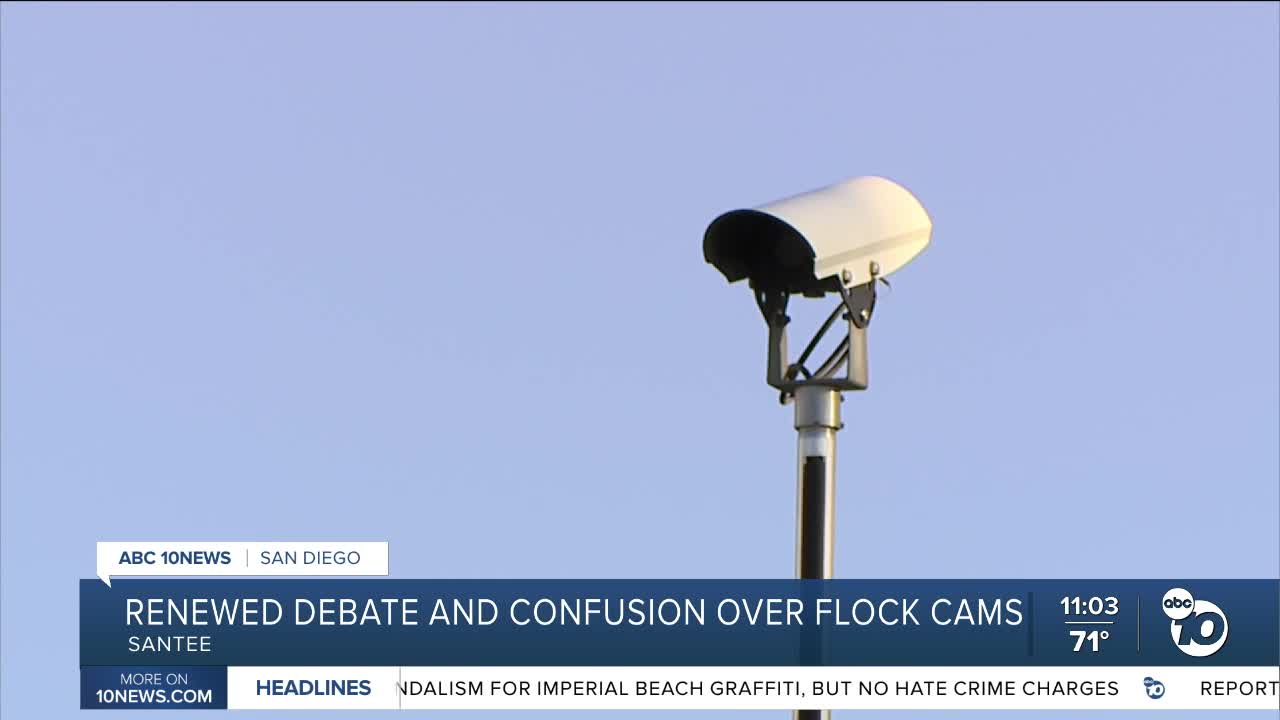


SANTEE, Calif. — Flock cameras have been getting a lot of attention online across San Diego County — and East County is no exception.
But in Santee, there’s also some confusion about what residents are actually seeing around town.
Not every camera mounted near an intersection is a Flock camera.
At the busy intersection of Cuyamaca Street and Mission Gorge Road, for example, cameras mounted near the traffic signals are traffic sensors used to help operate the lights.
Just down the road, near Target and Home Depot, are automated license plate readers, or ALPRs. Those cameras are designed to capture license plate information and can be used by law enforcement as an investigative tool.
The distinction has become increasingly important as residents discuss the growing number of cameras appearing around Santee.
Santee has grown significantly over the years, something longtime resident John Olsen has watched firsthand.
“When we first moved to town, not every sidewalk was paved, not every street was paved,” Olsen said.
Now, automated license plate readers are among the latest additions to the community.
Olsen said he considers himself a strong supporter of individual rights, but believes law enforcement should have tools to help investigate crime.
“I’m a big freedom of speech guy, big freedom rights guy,” Olsen said. “But we have these things anyway.”
He said the technology could help police track vehicles connected to crimes and potentially deter some criminal activity.
ALPR technology is not new, but the conversation around it is picking up again online.
Residents have raised questions about what the cameras are, what information they collect and how that information can be used.
ALPR systems generally use cameras to capture license plates along with information such as the time and location of the vehicle. California law places restrictions on how ALPR data can be collected, retained, accessed and shared.
That makes the distinction between traffic sensors and ALPR cameras especially important.
The cameras at Cuyamaca Street and Mission Gorge Road are designed to detect traffic conditions and help control the signals.
The ALPR cameras located farther down Cuyamaca Street serve a different purpose.
Back in June, Santee Mayor John Minto said the city was moving forward with plans to install six ALPR cameras in the community, with the possibility of additional cameras in the future.
“This is absolutely about keeping the public safe,” Minto said. “The more tools that our law enforcement agencies have, the better they can do.”
The Santee Sheriff's Office has similarly described ALPR technology as a useful tool for law enforcement.
For Olsen, the potential benefit is helping investigators identify suspects after a crime.
“It’s a modest deterrent,” Olsen said. “I don’t think that it’s going to stop something bad from happening to you, but we’ll be able to find the bad guys and hopefully that will help deter people from doing it.”
While Santee is moving forward with ALPR technology, neighboring El Cajon is facing a legal battle over how license plate data is shared.
California Attorney General Rob Bonta sued the City of El Cajon in October 2025, alleging the city was unlawfully sharing ALPR data with out-of-state law enforcement agencies. The Attorney General's Office said the El Cajon Police Department was sharing the information with more than 100 agencies outside California.
Bonta's office argues that California law limits the sharing of ALPR data with federal and out-of-state law enforcement agencies. El Cajon has disputed the state's position, and the legal fight remains ongoing. In January 2026, Bonta filed another motion asking the San Diego County Superior Court to order the city to stop sharing the data.
The case has put privacy and data-sharing practices at the center of the broader conversation over ALPR technology.
Across East County, residents are now weighing the potential public-safety benefits of ALPR technology against questions about privacy and how license plate data can be used.
In Santee, supporters say the cameras give law enforcement another tool to investigate crimes.
Critics and privacy advocates have raised concerns about the collection and sharing of information that can reveal where vehicles have been.
As more cameras appear around the region, one thing is clear: understanding what each camera actually does is becoming an important part of the conversation.
