

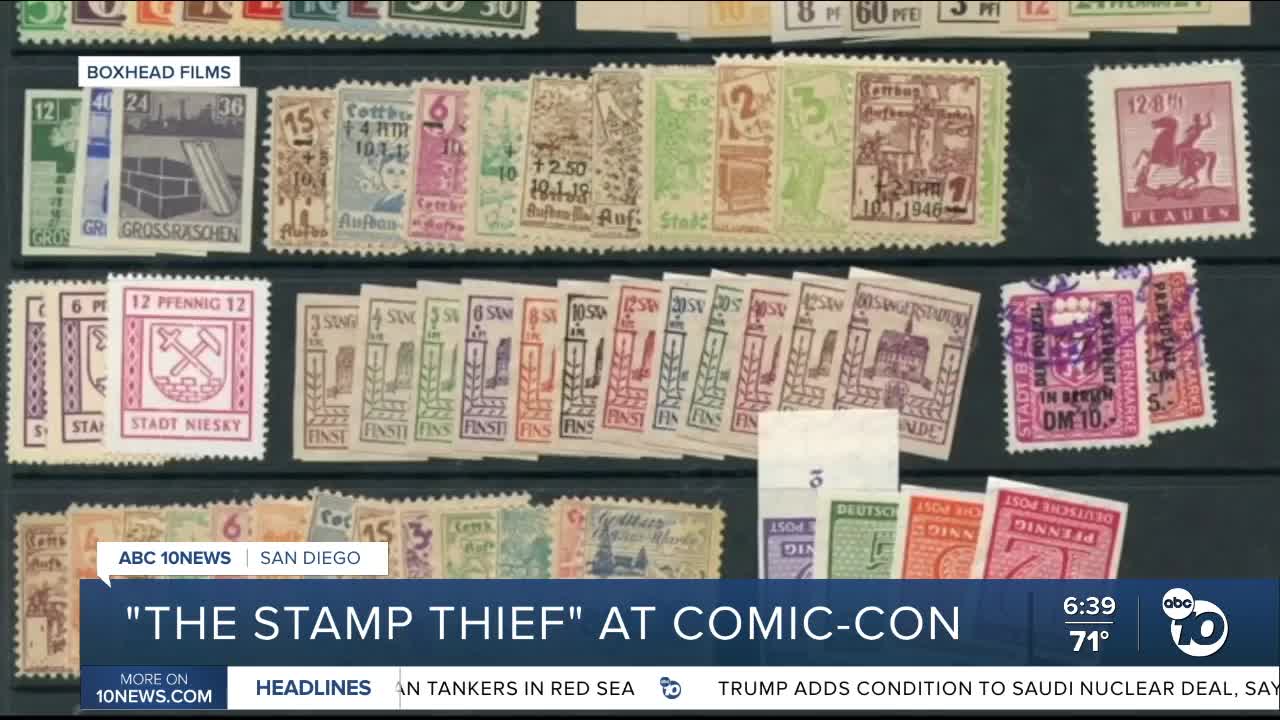



SAN DIEGO (KGTV) - A new documentary about a Nazi commander who stole stamps from Jewish victims as they were sent to Auschwitz is making its way to Comic-Con — and you don't need a badge to see it.
"The Stamp Thief" follows the theft of a rare and valuable stamp collection, the search to find it, and the sometimes unexpected turns the filmmakers encountered along the way.
"We made a film that we think is essentially a heist movie, but it's about history," says Director Dan Sturman.
Sturman and Producer Gary Gilbert, who is also one of the creators of Seinfeld, will be part of a panel at Comic Con Thursday morning to discuss the film. It's scheduled for noon in Room 4. Because the panel is only an hour, they won't be able to show the movie during it.
So, Gilbert and Sturman will screen the movie for free Thursday night at a synagogue downtown. The public is invited to attend, but advance registration is required.
Sturman said the documentary is about more than recovering stolen property.
"Holocaust history, knowledge of the Holocaust is diminishing, and I think that one of the ways that people are trying to teach history is by rescuing artifacts and creating some sort of physical connection," Sturman said.
Producer Gary Gilbert said the search to recover the collection — and the possibility of returning it even to a single person — carried deep meaning.
"I think it's because the Holocaust is such a horrific moment in our history, and you kind of wish you could go back and make it not happen. And I said, well, I can't do that, but what I can do is maybe have a tiny bit of justice," Gilbert said.
Getting to the stamps, believed to be buried in a building in Poland, required an elaborate ruse Gilbert compared to the film "Argo" — a fake story to get inside.
"The idea of the big shoot was saying, 'How can we, how can myself and a number of my friends show up with shovels in a basement in Poland and not get caught? What can I say to the people in that building?'" Gilbert said.
His solution was to invent a personal narrative to justify their presence.
"We were trying to figure out how to get in. The only way to get in to me, and spend a few days, was to create a story where we would be allowed to be there, and that's when I wrote the story about my grandparents and their illicit kiss and their meeting," Gilbert said.
The circumstances of that ruse — and the filmmakers' own inexperience — gave the documentary an unexpected comedic quality.
"We went on a search, and we went to see what we could find, and because of who we are, because of the situation, and because of some of our lack of experience, it became comedic in a way," Gilbert said.
That tone, Gilbert said, transformed the film into something the team never anticipated.
"It became an entertaining-that's the word people use when they see it-an entertaining Holocaust film. That itself makes it way more accessible than so many of the other films," Gilbert said.
Gilbert said the comedy never comes at the expense of the film's serious subject matter.
"At no point did we ignore the fact that this is a film about the Holocaust. It's a film about anti-Semitism. It's a film about current anti-Semitism. So, it is really apropos, you know, these days, especially for younger audiences at Comic-Con, for them to hear a story about the Holocaust in a way that I think they'd be able to sit for 90 minutes without grabbing their phones," Gilbert said.
Holocaust-related programming at Comic-Con is not new. Sandy Scheller, the curator behind the "Remember Us the Holocaust" exhibit in San Diego, has hosted a Holocaust-related panel at Comic-Con every year since 2018. Comics have a long history with World War II, from superheroes to propaganda.
Scheller said the focus on stamps — and the individual stories attached to them — is what makes the film resonate.
"We're talking about the smallest, tiniest, tiny, think about something like that that goes all the way around the world in a stamp. And what that means," Scheller said.
Scheller said the film works on multiple levels.
"First of all, the movie is truth in history. Second, it's a documentary. Third, it's written and put together by a Seinfeld writer. And when you follow the journey, you're on the edge of your seat," Scheller said.
"The whole time you're looking at the movie, you go, 'I didn't know that. Did this really happen?' And that is the joy of this movie," Scheller said.
You can watch the full interview with Gilbert and Sturman in the video player above.
This story was reported on-air by a journalist and has been converted to this platform with the assistance of AI. Our editorial team verifies all reporting on all platforms for fairness and accuracy.
