

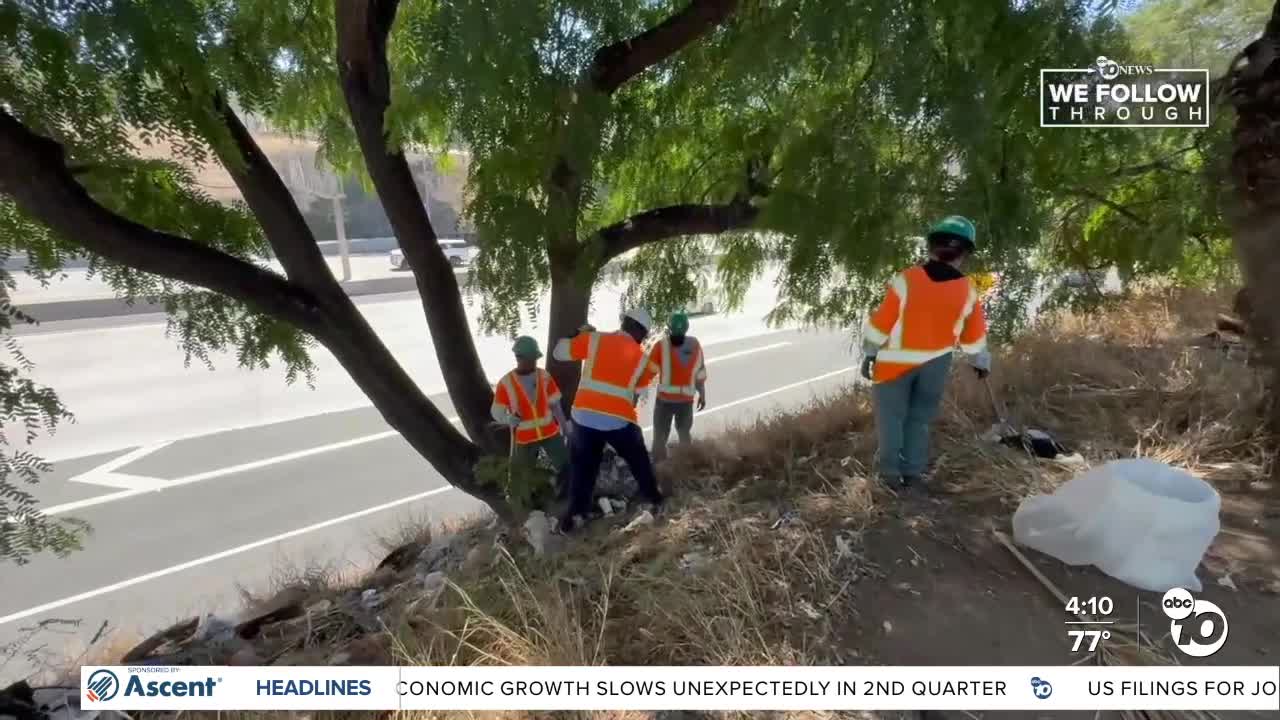


SAN DIEGO (KGTV) – Crews from the City of San Diego spent Thursday morning working along I-5 in downtown San Diego clearing what was left of a large homeless encampment.
Things like bikes, an armchair, a big outdoor umbrella, a TV, and a ’70s swing chair were just some of the things picked up and tossed in a garbage truck. Not to mention, there was plenty of trash and debris littering throughout the area.
“So after our first year we're able to remove over 413 tons of trash, did over 800 abatements,” Franklin Coopersmith, Deputy Director of the City of San Diego’s Environmental Services Department, said.
It’s where City of San Diego crews are doing homeless encampment clearings along our freeways within this five-mile radius. Crews are able to do this with a pilot program agreement with Cal Trans. The agreement was just renewed this week.
“In our previous agreement, the only authority that we have were to provide outreach services as well as the abatement which includes the posting notices as well as the removal and clean up,” Coopersmith said. “With this one we now are able to go into separate areas and do weed, graffiti, uh, other illegal dumping waste and debris.”
ABC 10News has spoken to Coopersmith multiple times about the agreement, its progress, and impact
It’s a program that San Diego Mayor Todd Gloria touted in his 2026 State of the City address in January.
“I want to do more because this agreement with Cal Trans has proven so successful,” Gloria said in January. “I am urging state leaders to expand it and allow city crews to cover more areas next to freeways where we know tent encampments exist.”
This renewed agreement between the City and Cal Trans that allows city crews to clear out encampments on state property is still for the same five-mile radius area that was in the pilot program. So why wasn’t it expanded, considering that’s what Mayor Gloria was hoping for in his State of the City address?
Coopersmith told ABC 10News that part of the reason is the cost.
“So even to just double the area, you're talking it could potentially be in the hundreds of thousands to millions depending on how much you expand,” Coopersmith said. “And at the time where the city is going through a budget crunch, the fact that we're not only able to maintain, but then, you know, keep these services going, we call that a win.”
Coopersmith said the City’s also applying for an Encampment Resolution Fund grant like what was done at the San Diego River and other locations to help cover more ground with a different resource.
The City said it’s been able to get 115 people into some type of shelter and 19 into permanent housing with the Cal Trans agreement.
'People have been able to be placed into the City’s Safe Sleeping Site because of its same-day availability, according to a City spokesperson.
“We do have a lot of people that just personally are not ready for themselves to go into a shelter option, and we do see that where, you know, they're not ready at that point,” Coopersmith said.
ABC 10News asked Coopersmith what their teams learned in a year’s time to ensure help those who are calling the highway home don’t return to an encampment area once it’s been cleared or to a different spot along the highway.
He said consistent contact with people is key to addressing that.
“So almost every area along this five-mile stretch will be done on a weekly basis because that's how you're going to get that contact,” Coopersmith said. “And what we found is sometimes it's not the 1st, 2nd, 3rd, and you know what, you might actually get someone that said, yes, I want a service today.”
