

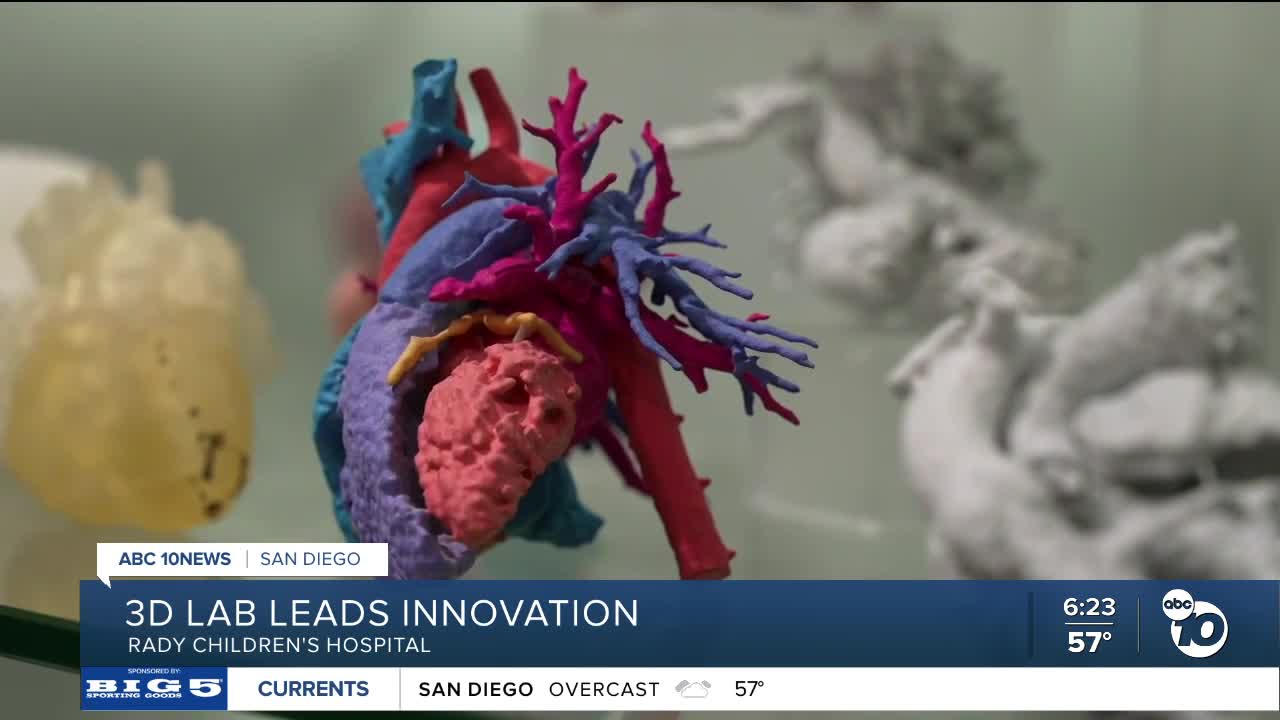


SAN DIEGO (KGTV) - With 3D printing revolutionizing the healthcare field, doctors at Rady Childrens Hospital are getting scale or full-sized models of organs and bones to help them, and their patients, prepare for surgery and treatment.
"We have cardiac models, orthopedic models, scoliosis models, neurosurgery models," said Dr. Justin Ryan, lab director.
Ryan gave ABC 10News anchor Jared Aarons a tour of the lab to explain the benefits of the different models they make.
"Very few hospitals have a 3D lab like this, built in this manner," Ryan said.
Ryan helped build the lab from scratch, starting in 2018. It now has seven 3D printers, from the most basic to specialized machines that can sterilize objects for the operating room.
"It's just starting to go ... you can see it's just a couple layers in right now," Ryan said during a demonstration.
Over eight years, the lab has printed 2,800 models for 2,073 patients. More often than not, the models are organs like hearts to help surgeons better visualize a procedure before they start an operation.
"We give a physical road map to our surgeons to allow them to plan a procedure. We can also print it in a flexible media so our surgeons can do mock operations directly on the model themselves," Ryan said. "They can practice on a model before stepping into the operating room."
Ryan said that makes surgery faster, cutting anywhere from 30 minutes to more than an hour.
"We're talking reduced rates of infection, reduced rates of incidents in the OR, less time under anesthesia, less time to create a situation of a stroke or other complications," Ryan said.
The models come from MRI and CT scans. Ryan's team, whom he calls "innovation engineers," turn those into a 3D blueprint that can be manipulated and studied before anything goes to print.
"You can peel away structures, you can put structures back, you can rotate things, hide and show things that you can only do once in a 3D print," Ryan said.
But the lab helps beyond surgery prep. Ryan's lab had used the machines to print medical devices or safety equipment like masks and face shields during the pandemic. They've made architectural models to show how doctors and patients will move between newly renovated rooms. And the models of organs and bones can be used to teach other doctors or to help patients better understand their surgery.
"So if we have a model like this, this is a hypoplastic right heart, with patent ductus arteriosus. So, pretty complex medical jargon. It's really challenging to have a family hear that diagnosis and understand it. But if you can tell them that this purple chamber is very small and it should be much larger, this green vessel shouldn't be there, we create a way to communicate with families," Ryan said.
That takes some of the fear away at a time when parents and their children are going through a scary situation. It's a model for better healthcare, printed one layer at a time.
The lab also does virtual reality, software development, and AI-based research to find the next big tech breakthrough in healthcare.
This story was reported on-air by a journalist and has been converted to this platform with the assistance of AI. Our editorial team verifies all reporting on all platforms for fairness and accuracy.
