



SAN DIEGO (KGTV) — For many Black Americans, tracing their ancestral roots is filled with challenges, roadblocks, and often leads to more questions than answers. This Black History Month, Yasmeen Ludy followed genealogist Yvette Porter Moore as she helps one San Diego family uncover a legacy deeper than they ever realized.
For many Black families, putting together their family history can be challenging. Yasmeen experienced that herself while trying to trace her own family's roots.
Yasmeen Ludy met Porter Moore, a local genealogist helping families navigate this journey. She was introduced to the Ritchey family, who believe they are one of San Diego's oldest Black families.
Yasmeen has been there every step of the way as Porter Moore uncovered just how deep the roots go in San Diego.
For many people, their family history is a roadmap to who they are – the way they look, the way they talk, the little oddities that separate them from the person next to them. The small code that makes you, you.
But of course, that's if you know your family history. Many Black families don't.
That's where Porter Moore comes in.
"You're gonna take the elevator, which is located on the right side, to the floor, walk all the way to your left," Porter Moore said, navigating through a San Diego mausoleum.
To help the Ritcheys uncover their past, her journey starts in the mausoleum, walking through halls of history, searching for a legend buried in the archives.
Genealogy became Porter Moore's calling as someone who was adopted, wanting to find her birth family. She first connected with the Ritchey family at San Diego High School when Johnny was being honored with a mural.
"I was pulled into do a little more research on Johnny Ritchie's ancestry and so that meant looking deeply into when the family started arriving in San Diego," Porter Moore said.
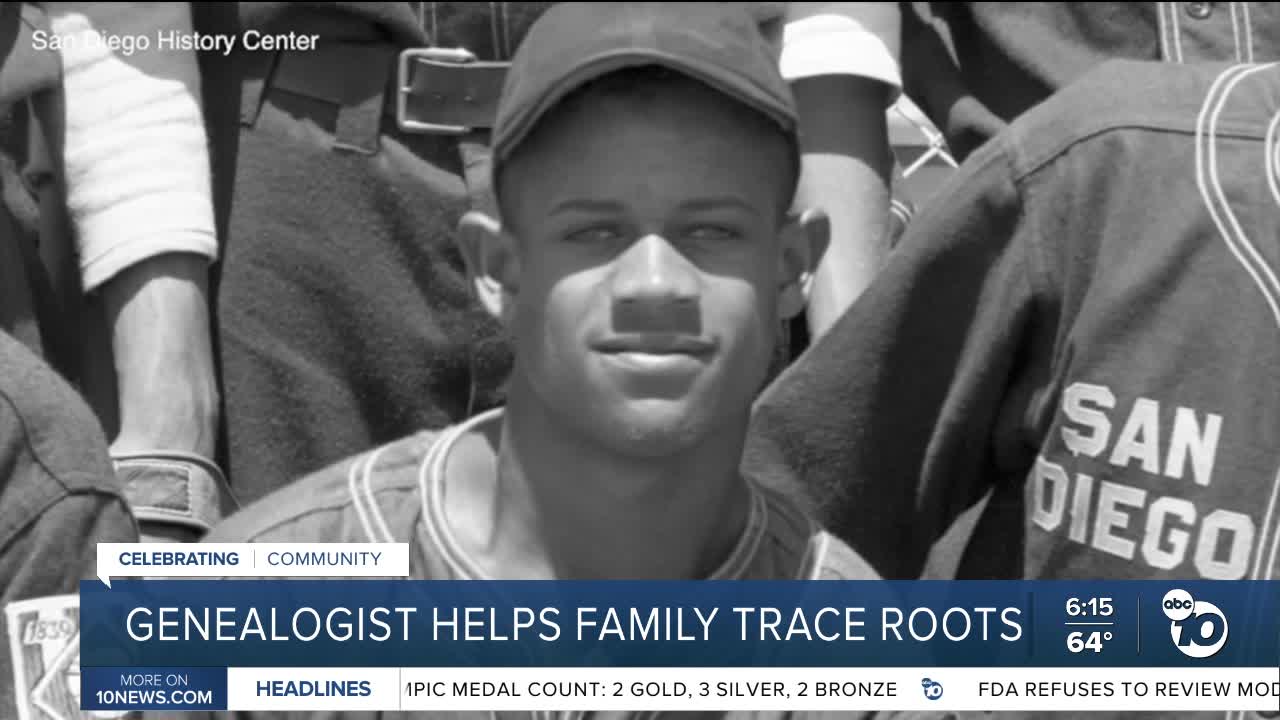
Johnny Ritchey was the first Black man to play for the Pacific Coast League Padres, which we know now as Major League Baseball's San Diego Padres. Ritchey was a catcher with the team in 1948 and 1949. He died January 14, 2003.
"His main significance is that he broke the color barriers in San Diego for the Pacific Coast League, where he played for the Padres, and he's like our Jackie Robinson of the West," Porter Moore said.
Porter Moore has been working with Johnny Ritchey's family for six months, traveling to burial sites and history centers, trying to fill in the gaps of his family tree.
"This was Johnny Ritchey's mother and father, and when you go up the maternal line, you see Thomas Debose and Christina Moss," Porter Moore explained while reviewing the family tree.
She continued, "Christina Moss having her maternal line, right now I'm trying to see if I can break the barrier."
That barrier is a wall many Black Americans hit when tracing their ancestry.
"African Americans, most would show up in the census in 1870 after slavery. There are times when African Americans showed up even before then, but they were usually free people of color," Porter Moore said.
Porter Moore says African Americans who were not free turn up on a different kind of record, making it harder for their family members to find them. Another challenge is that many don't even know their relatives' names, when they were born, when they died, or who they belonged to.
"Usually it will be in property records because African Americans were considered property and because we were from chattel slavery," Porter Moore said.
According to the National Archives, people who were enslaved appeared in the 1850 and 1860 census on what was called "slave schedules." The document only showed the slave owner's name, how many enslaved people they had, their gender, age, and whether they were deaf, mute, or blind.
"During slavery times, families were sold off, you know, could be sold across the water, you know, to a different state to a different county, and once they were separated, it was really hard to find one another," Porter Moore said.
Not to mention, slavery went on for hundreds of years.
Despite the challenges, Porter Moore is determined to help Black families trace their roots as far back as the records will take her. As she sifts through the paper trail, she'll help Johnny Ritchey's family uncover where their story begins.
"I really strongly believe that the ancestors want to be found," Porter Moore said.
Months have gone by since I first sat down with Porter Moore, but I recently had the chance to sit down with both Porter Moore and members of the Ritchey family at their home, where she revealed what she uncovered about their family history.
This story was reported on-air by a journalist and has been converted to this platform with the assistance of AI. Our editorial team verifies all reporting on all platforms for fairness and accuracy.
