


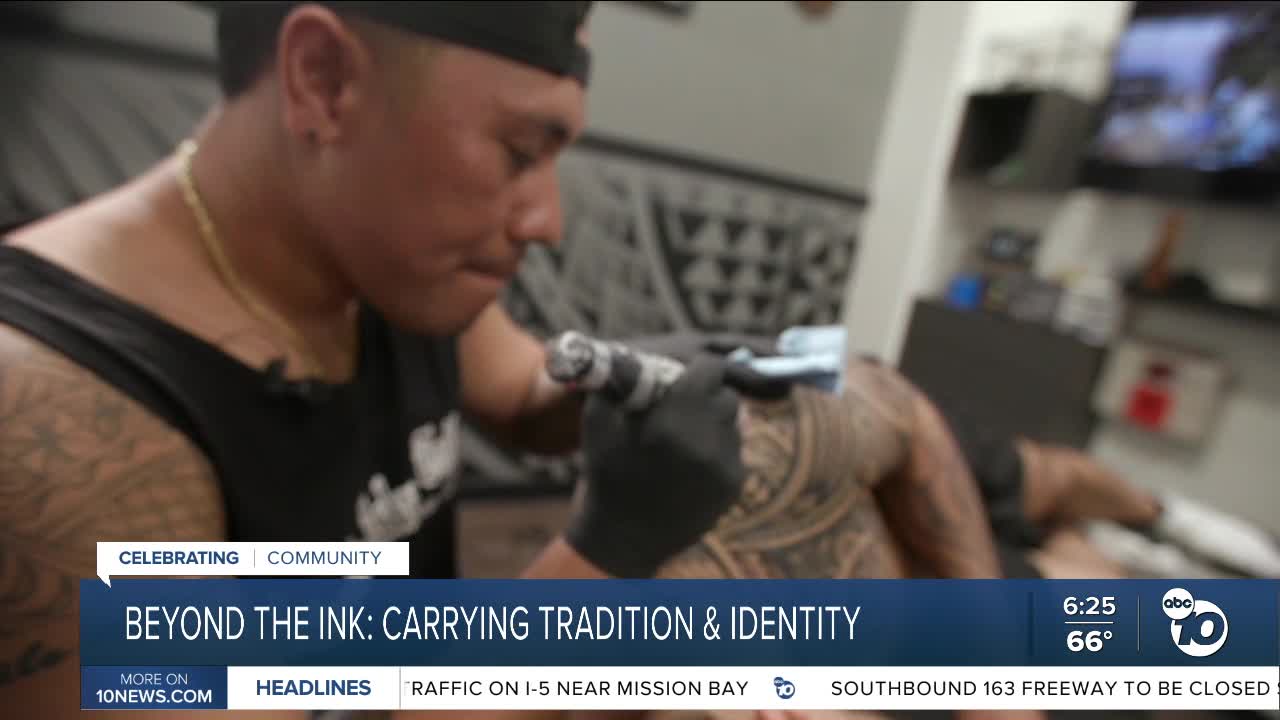

For Pacific Islanders, tattoos are more than artwork.
They are identity. Family. History.
A permanent reminder of where someone comes from — and who they carry with them.
Inside his San Diego shop, Friendly Island Tattoo, tattoo artist Kiti Vailea is helping preserve a tradition that has connected Polynesian families for generations.
The tradition is called tatau — a sacred cultural practice that dates back more than 2,000 years across Polynesian islands.
“It’s very important to customize every piece to everybody’s story because everybody’s story is different,” Vailea tells me.
The buzzing of the tattoo machine fills the room as clients sit for designs rooted in culture and ancestry. But for Vailea, the work goes far beyond ink on skin.
“I look at how is this tattoo gonna remind themselves of where they come from,” he said.
Traditionally, tatau symbolized strength, achievement and rites of passage. Today, many Pacific Islanders use the markings to stay connected to their roots — especially those raised far from the islands their families once called home.
“Most of the symbols — the family, they travel and leave the island to be far away from home,” Vailea explained. “But to have a symbol on them.”
For Vailea, that connection is personal.
Born and raised in Tonga, on the small island of Vava'u in the South Pacific, he moved to the United States roughly a decade ago, searching for opportunity and a better future for his family.
But the transition was not easy.
“My first year here, I struggled just finding a job,” he said. “I got homesick and told my wife I wanted to go home so bad.”
He says one of his biggest challenges was insecurity surrounding his English.
“I think that’s my biggest struggle,” Vailea said. “I was very insecure about my English.”
Eventually, he began tattooing professionally — a career that would ultimately reconnect him with his culture in a new way.
“It’s been six years I’ve been tattooing professionally,” he said.
Now, clients from across the country — and around the world — travel to work with him.
“This year has been a busy year, nonstop,” Vailea said. “We’re fully booked out for the year.”
He says tattooing has become more than a career. It has become his purpose.
“To be able to connect with people — that’s what I love,” he said. “To be able to share the culture, share my life basically.”
The journey, he says, has brought him closer to home.
“When I move here, it was more special and I feel more at 'home' when I do this,” Vailea said.
While modern tattoo machines have replaced the traditional hand-tapping methods once done using bone combs, the meaning behind tatau remains the same.
It is a story.
A map of ancestry.
A connection between generations.
And for many younger Pacific Islanders born in the United States, Vailea says the art opens the door to conversations about culture and identity.
“To pass on this — most of our people here, they are born here, they never been to the island,” he said. “But to be able to have that conversation and educate them more about our culture — I was like, this is my calling.”