

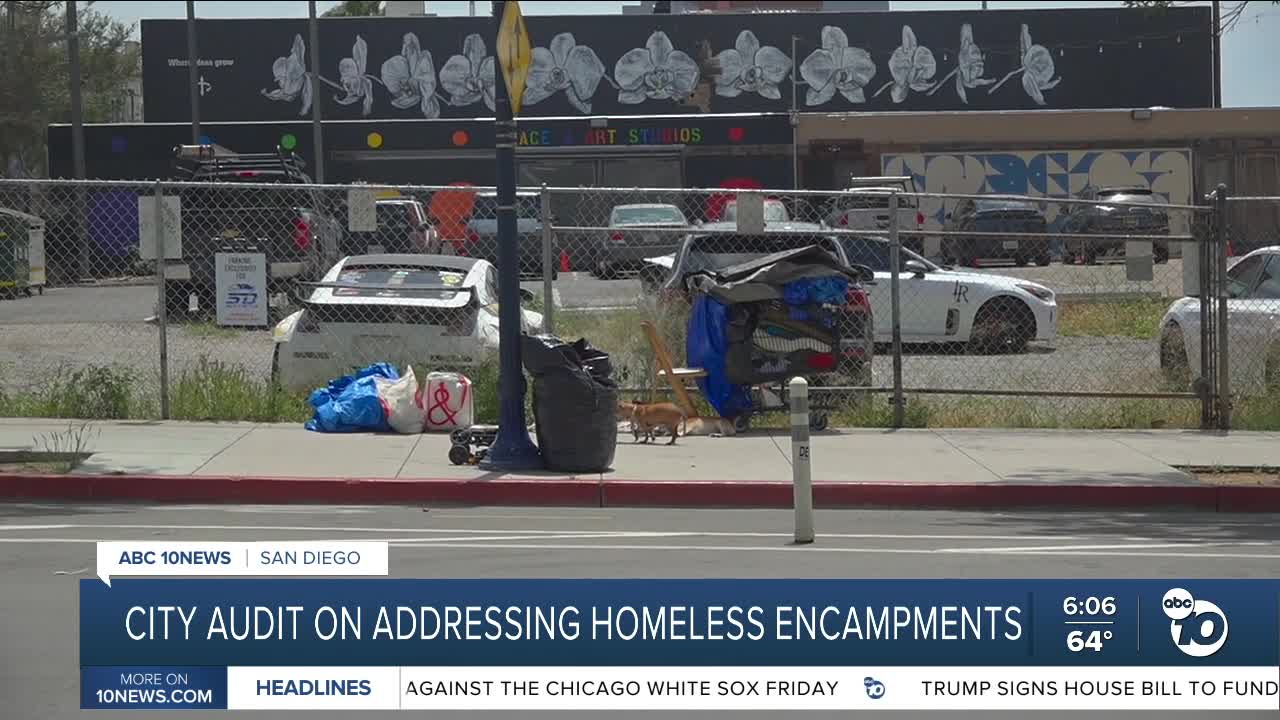


SAN DIEGO (KGTV) — A new report from the City of San Diego Auditor details how the City has addressed the clearing of homeless encampments since the passage of the Unsafe Camping Ordinance.
The audit looked to address five main questions:
- Did the unsheltered population decrease in the City of San Diego since the implementation of the Unsafe Camping Ordinance?
- Did the unsheltered population move from downtown to other areas of the City of San Diego after the implementation of the Unsafe Camping Ordinance?
- Did the number of citations, arrests, and prosecutions for encampments increase after the Unsafe Camping Ordinance?
- Did City departments work and coordinate in their response to encampments after the implementation of the Ordinance, in accordance with the goals in the preamble of the Ordinance?
- Does the City equitably store personal items from abatements?
It also showed that the overall unsheltered population in the City hasn’t declined by much since the ordinance went into effect, even though it appears that fewer people are living on the streets.
“What we did see was at the same time that this ordinance went through, that our safe sleeping went online, and that was an opportunity to get hundreds of people into our safe sleeping,” Franklin Coopersmith, Deputy Dir. of Environmental Services Department, City of San Diego, said.
Coopersmith’s department is tasked with clearing homeless encampments.
ABC 10News spoke with him about the audit and the five questions that it aimed to answer.
Coopersmith and the audit explain that those safe sleeping sites are still technically considered unsheltered, according to the Department of Housing and Urban Development.
"Our safe sleeping is not considered an official shelter, so it is still considered unsheltered,” Coopersmith said. "Though when the public looks, they don't see as many people on the street is because they're in these places where we designate that they can go in. We have shelter there. We have resources, we have beds for them.”
When it comes to the movement out of Downtown San Diego, the audit said there’s not enough data to show that reports of encampments in other areas, but are not ruling it out. The report found that arrests and citations increased.
The report also found that Get It Done request times for encampments from both the San Diego Police Department and Environmental Services went down since the ordinance.
“With this ordinance, we work closely with the neighborhood policing, which has the HOT team, the homeless outreach team,” Coopersmith said. “I mean, that was a great tool in addition to homeless outreach workers, you have this hot team that's out there that's able to make contact and get people into shelter just as easily as an outreach worker is.”
The audit says the city could do a better job at storing personal items found in encampments. Coopersmith’s department agrees with and plans to make things more accessible and review how other cities store those items.
“I think we did a really good job pointing out that homelessness is extremely complicated. There are many needs out there and a single ordinance is not what's going to solve it,” Coopersmith said.
Homelessness service provider People Assistance The Homeless, also known as PATH San Diego, sent ABC 10News the following statement after the release of the audit:
“PATH participated in the City’s audit of the Unsafe Camping Ordinance with the goal of improving outreach outcomes and supporting healthy, safe public spaces. We maintain strong working relationships with partners across the region, including the City of San Diego, and we look forward to continuing this collaboration.
No one should be living unsheltered or in encampments. That is why PATH focuses on providing outreach and street-based case management to help our unhoused neighbors move indoors and onto a path toward stable housing. Effective outreach requires time, trust, and coordination. We have consistently advocated for outreach to serve as the first step when clearing and addressing encampments in public spaces.
Our experience shows that providing at least 72 hours’ notice, ideally up to one week, leads to better outcomes. This timeframe allows outreach teams to build connections and link individuals to appropriate services and shelter. When dedicated shelter beds are available for a specific encampment and immediate placement is offered, acceptance rates increase significantly. When adequate notice and time are not provided prior to sweeps, significant setbacks occur in our efforts, as individuals often lose critical documents and service connections necessary for securing housing.
We hope our additional feedback will be taken into consideration as we continue working to support unsheltered San Diegans in transitioning off the streets and into stable housing. “
The report also states that as shelter referrals increased, including safe sleeping, with the ordinance going into effect, space was limited, so most of those requests couldn’t be met.
Paul Armstrong from the San Diego Rescue Mission said that more beds would be more helpful.
“But also, I think we need to look at the relationship between outreach and the shelter system. And as our shelter system turns into long-term housing, how much turnover is happening in our shelter system?” Armstrong said. Because that's part of it is we need a high-functioning shelter system that's integrated with outreach.”
