

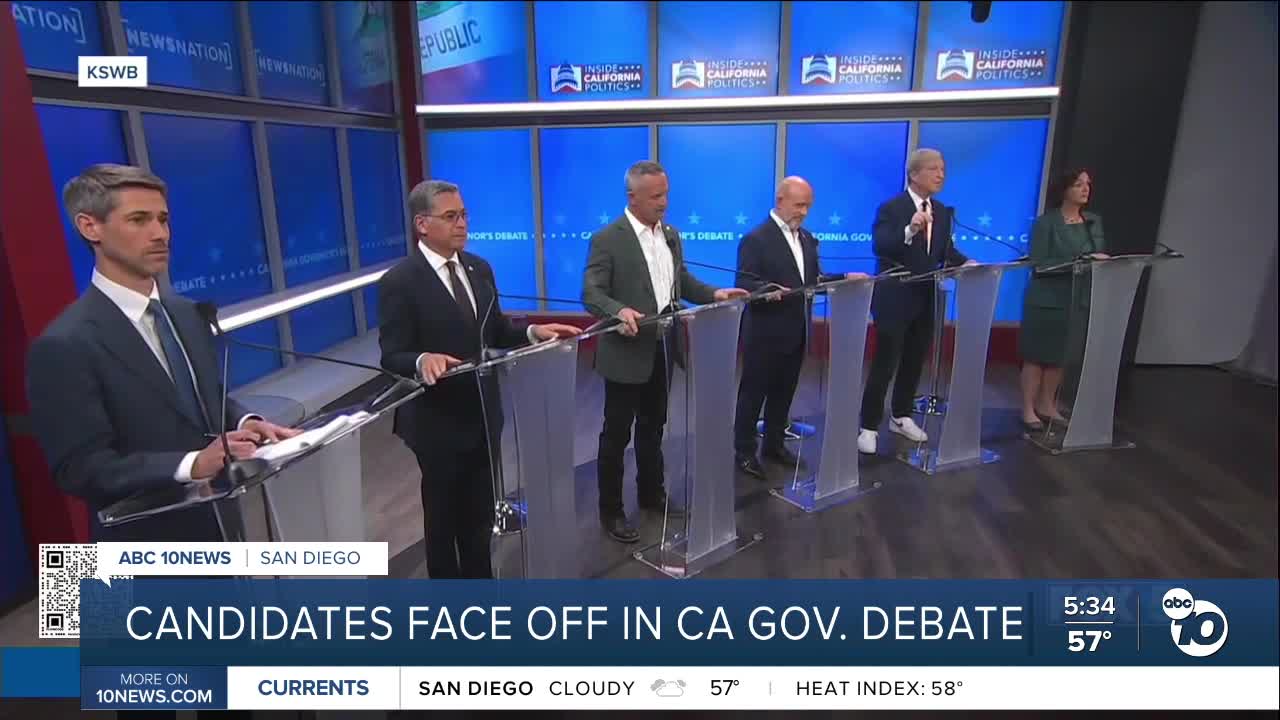


Six candidates. One stage. And a debate that could shape the race for governor of California.
The high-stakes showdown put the spotlight on the biggest challenges facing California — from housing and homelessness to public safety and the rising cost of living.
But as candidates traded attacks and outlined their visions, the lingering question remained: Did anyone do enough to truly stand out, especially with voters in San Diego?
Katie Porter framed the race as a question of trust, telling voters, “This election is about who you can trust to fight for you.”
Meanwhile, Tom Steyer leaned into his outsider image, saying, “When you say I’m the only billionaire in the race—yes—but I’m the person who is the change agent in this state.” Earlier in the debate, he added bluntly, “They’re scared of me.”
The partisan divide was also front and center. Republican candidates Chad Bianco and Steve Hilton pushed for sweeping change after years of Democratic leadership.
Hilton criticized the state’s direction, saying, “We’ve had 16 years of one-party rule — it’s given us the highest poverty rate, the highest unemployment rate, the highest cost of living in America. It is obviously desperately time for change in California.”
On the Democratic side, experience and leadership took center stage. Xavier Becerra argued California needed steady leadership during challenging times.
“California is going through a crisis and we need someone who knows how to govern in crisis, not someone who’s gonna need training wheels the moment they walk into the governor’s office,” Becerra said.
The Chair for the San Diego Democratic Party, Will Rodriguez-Kennedy, shared his perspective on how candidates performed—and what matters moving forward.
“What the game is right now is about getting undecided people to a candidate,” he said, noting that the race is far from settled.
Rodriguez-Kennedy also criticized Republican candidates, saying, “We saw the Republicans kind of showboating without an actual plan for the state… and in fact, some detrimental plans.”
Still, he emphasized the importance of connecting with voters in regions like San Diego, where key issues hit close to home.
“The more they get here, the better it is for them because they’re going to want to pick up the millions of voters that we have here,” he said.
He added that the region’s unique challenges could shape the race moving forward.
“San Diego really is interesting in that all the major issues touch on our local region… they need to lean in on that in a way that makes us think that we’re being heard.”
Even within his own party, Rodriguez-Kennedy acknowledged a split in preference, saying, “I have been torn between Xavier Becerra and Tom Steyer, and they’re very different in terms of approach and in terms of policy.”
With major issues like housing, homelessness, and affordability dominating the debate, candidates made their case—but no clear frontrunner emerged.
And with more debates and campaign events still ahead, the pressure is on.
If candidates want to stand out, they’ll need more than strong debate moments—they’ll need to prove they can connect with voters where it matters most.
