

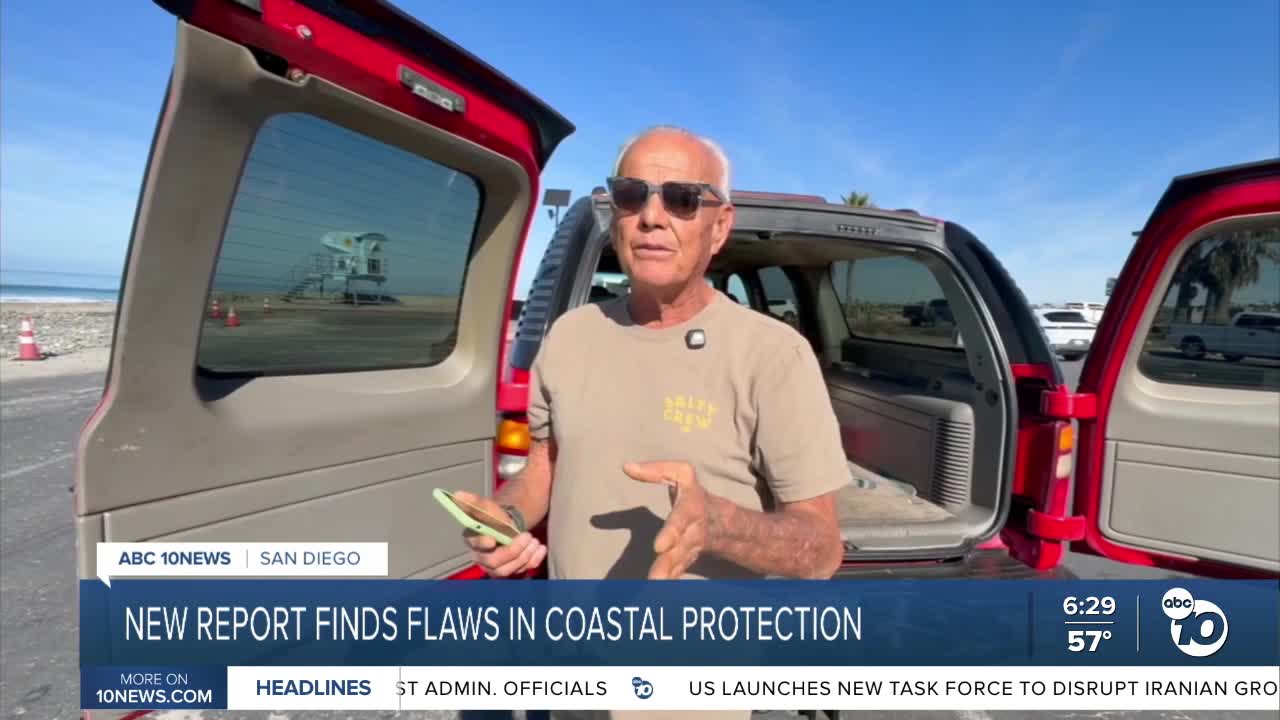


One parking lot in Solana Beach can flood when high tides roll in.
With stronger storms and rising seas putting more pressure on our coastline, a new report is looking at what we're getting right ,and wrong, when it comes to protecting our beaches.
“I was a Seaside kid and made my way here,” Johnny Seaside says.
Seaside has spent most of his life along this stretch of coast. He even lived right here when this parking lot was a trailer park. But over the years, he's watched the beach change. And the water get closer.
“You can walk down the beach and you see where all the houses are just hanging with no backyard at all,” Seaside says.
It's a problem that's only expected to get worse as sea levels rise and stronger storms put more pressure on the coast.
But Surfrider Foundation says some of the ways we're trying to protect our shoreline may be making things worse.
“We see seasonal flooding, we see the beach shifting, we see developments stopping our ability for the beach to move and migrate,” Alex Ferron Mignogna, Coastal Adaptation Manager with Surfrider Foundation, says.
That's a central concern in Surfrider's 2026 State of the Beach Report. It graded 30 coastal states on their shoreline protection policies. Twenty-seven received a C or lower.
Not one got an A.
California has some protections in place. But Surfrider says the state needs to do a better job defining what counts as an emergency — before communities wait until it's too late. Because that's when seawalls and rock armoring often come into play.
“Walls on the beach fix the back of the beach, so the coast can't shift any longer. And that results in scouring of the beach, so a removal of sediment, sand, beach, cobble, all of the stuff that makes a beach a beach,” Mignogna says.
Those walls can help shield property. But they also interrupt the natural movement of the coast, making it harder for sand to replenish the beach.
Instead, Surfrider is pushing for nature-based solutions, like the Cardiff Living Shoreline, where cobble and dunes help absorb wave energy while allowing the coast to shift.
“If we shifted and just went to reactionary walls all over beaches as our form of coastal planning, we'll just lose our beaches,” Mignogna says.
And for this former Seaside resident, losing more of the beach isn't something he wants to see.
“This is going to keep going on and on, and it's not going to stop,” Seaside says.
