

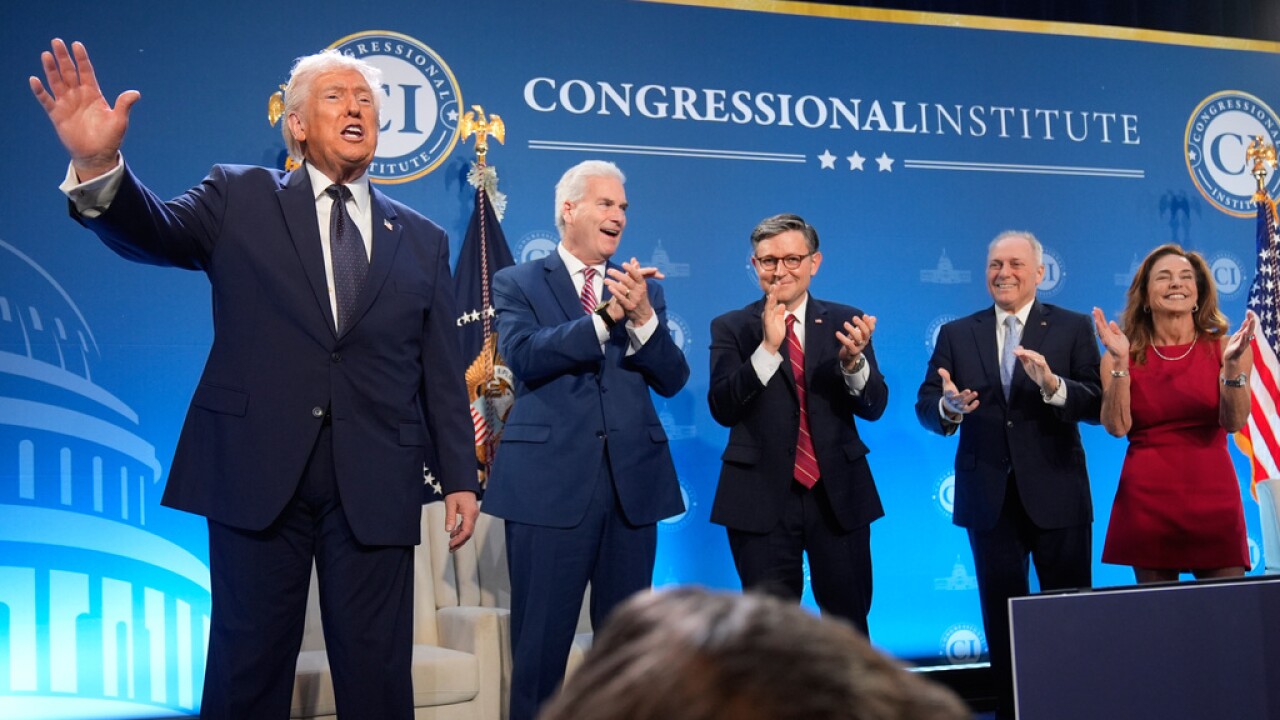

For the second year in a row, House Republicans this week decamped to the Trump Doral in Miami for their annual policy retreat. The respite from legislating in Washington comes as Republicans have struggled to unite around a cohesive agenda in the final months of the current Congress and ahead of the midterm elections, finding themselves hamstrung by an ever-shrinking majority.
The slim margins in the House have consistently presented challenges for House Speaker Mike Johnson, who has, at times, been unable to corral his one-seat margin to pass the president’s agenda. On Monday, President Donald Trump attended a private fundraiser held by the House speaker in Miami, on the sidelines of the GOP retreat. On Tuesday, a spokesperson for Johnson told Scripps News the fundraiser raised $20 million for House Republicans’ efforts to retain or expand their narrow majority in the midterm elections. It represented the largest amount ever raised by Johnson in a single roundtable event. But even flush with cash for campaigns, Republicans still face hurdles ahead of the November general election.
One year ago, at the same venue in Miami, talk of Republicans’ reconciliation bill, the One Big Beautiful Bill Act, dominated the 2025 retreat. Early in the 119th Congress and President Trump’s second term, Republicans sought to leverage their majority to codify many of their and President Trump’s campaign promises, including eliminating taxes on tips, overtime, and sunsetting green energy credits passed by the previous administration. But, in the months since the policy megabill’s passage last year, chances of a second reconciliation package, one potentially seeking to make changes to President Barack Obama’s signature Affordable Care Act plan, long a target of Republicans and President Trump, appear to have all but evaporated. Last year, Republicans were able to pass the bill despite their slim majority, using a complicated process called reconciliation, which allows the party that controls the critical ‘trifecta’ (the House, Senate, and the White House) to pass bills that are not subject to the Senate’s 60-vote filibuster threshold.
IN CASE YOU MISSED IT | GOP Rep. Tony Gonzales ends reelection bid after admitting to affair with aide
In a brief text exchange Tuesday, Republican Congresswoman Victoria Spartz of Indiana, who is attending the retreat, said she did “not think reconciliation is feasible in an election year.” Instead, Spartz told Scripps News, she believes that Republicans “still need to move some bipartisan legislation, such as health care price transparency,” which President Trump pushed for in his State of the Union address last month.
As chances for a second reconciliation bill have dimmed, Congressional Republicans have placed renewed focus on touting their first reconciliation bill, which Republicans have retroactively rebranded as the ‘Working Families Tax Cut.’ Since the megabill passed last year, Republicans’ ever-dwindling majority has at times yielded uncomfortable realities for President Trump’s second administration, as Democrats have sought to exploit divisions within the Republican conference, including a successful push on an effort to release the files of convicted sex offender Jeffrey Epstein, a drive that the administration had attempted to squash, summoning Republican defectors including Rep. Lauren Boebert, R-Colorado, to the White House, before embracing the measure. Its passage was nearly unanimous through the Republican-controlled Congress last year.
One of the most vocal thorns in President Trump’s side, however, has come from within his own party. Rep. Thomas Massie, R-Kentucky, who served as the lead Republican proponent of the Epstein Files Transparency Act, has shown no qualms about standing up to President Trump. The president, in turn, has endorsed his opponent in his upcoming primary election and repeatedly derided him on Truth Social, though House Speaker Mike Johnson has avoided criticizing members of his slim majority directly.
This year’s retreat and President Trump’s attendance come at a particularly perilous moment for Republicans’ legislative agenda. Despite an ongoing partial government shutdown affecting the Department of Homeland Security, President Trump has repeatedly pushed his party to pass the newly retooled SAVE America Act, threatening on Truth Social over the weekend to “not sign any other Bills until this [Save America Act] is passed.” The sprawling bill, championed by conservatives, would effectively nationalize some aspects of elections, including requiring voter ID and proof of citizenship to register to vote, and place major restrictions on the use of mail-in ballots, along with banning transgender women from competing in women’s sports and outlawing gender affirming surgeries for minors. A bill addressing the election-related aspects of the president’s push passed the House last month is all but certain to fail in the Senate due in part to the filibuster rules.
IN CASE YOU MISSED IT | Americans remain skeptical of Trump agenda following State of the Union, poll says
“I know he’s passionate about the ‘Save America Act’, and I think that his statement was an expression of that,” Senate Majoirty Leader John Thune told reporters Monday on Capitol Hill. “I hope at the end of the day that we can move things across the floor here and actually put legislation on his desk that he’ll find his way to signing.”
In a press conference Monday, President Trump appeared to partially walk back his threat to hold up all legislation, telling reporters in part, “certain things will happen. Certain things will take place.”
Still, with a slim majority in Washington, and months to go before the midterm elections, Republicans face an uphill battle to buck typical midterm trends and retain control of both chambers of Congress in the midterm elections. Currently, House Republicans can only afford to lose one vote on most legislation that passes on a party-line vote.
At a retreat that was intended, in part, to get all members on the same page, not all attended. Only 130 House Republicans RSVP’d for the retreat, out of 218 total. By the second day, many Republicans also couldn’t seem to agree on whether to move forward with a second reconciliation deal.
On Tuesday, NOTUS reported Tom Cole, the Republican chairman of the House Appropriations Committee, spoke out against moving forward on another reconciliation bill. But hours later, he appeared to reverse course. On X, Cami Mondeaux of Deseret News, posted Cole told reporters that he was “for a second reconciliation package,” adding, “if we can agree what it is.”
Senior Congressional Producer Sam Lisker contributed to this report.
