

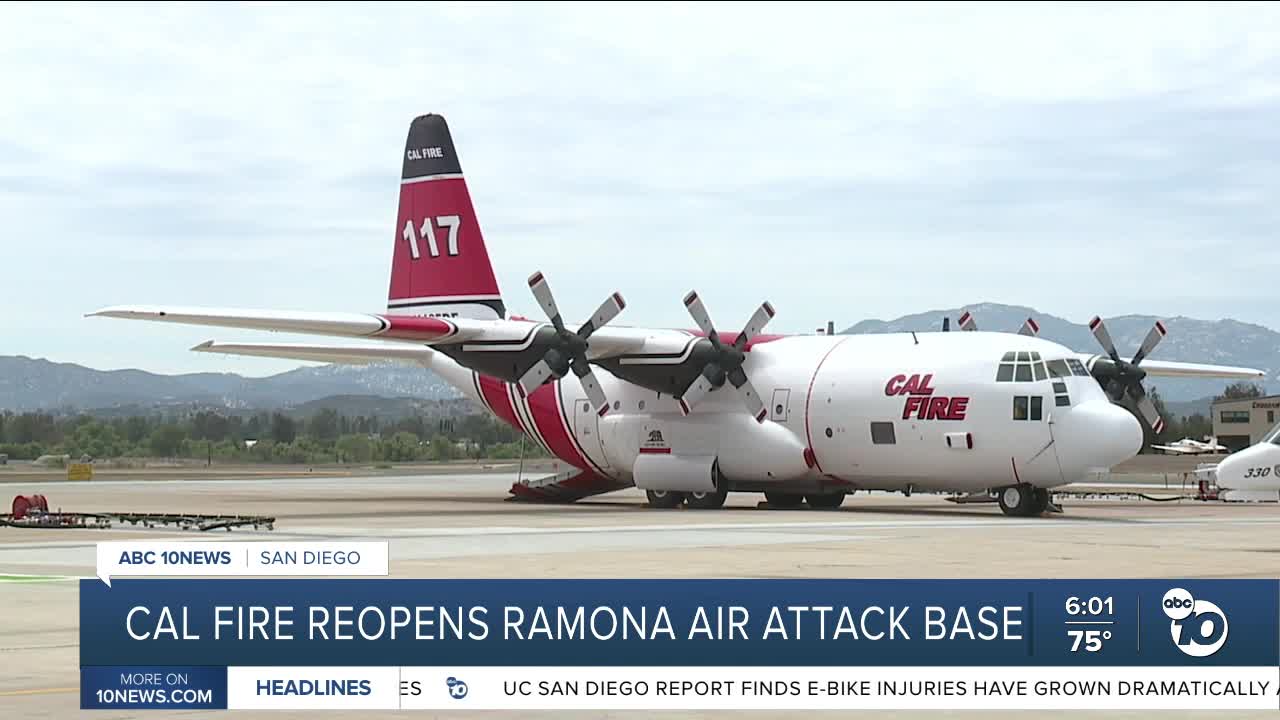


RAMONA, Calif. (KGTV) — As wildfire season intensifies, Cal Fire has officially reopened the Ramona Air Attack Base following a major rebuild — bringing with it expanded air power and faster response capabilities for San Diego County.
The base is now home to one of the largest firefighting aircraft in Cal Fire's fleet: a C-130 Hercules air tanker capable of carrying up to 4,000 gallons of fire retardant. The base also houses a new Cal Fire Hawk helicopter, giving crews a more powerful combined aerial response to fast-moving wildfires.
Behind the scenes, the rebuild addressed aging infrastructure that had slowed operations for decades. The original base was constructed in 1957, and outdated, undersized pipes had made refueling a lengthy process.
Fire Chief Tony Mecham said the improvements have already changed what crews can accomplish in the critical early moments of a fire.
"The infrastructure was built here in 1957, so you know we had pipes that were, you know, 70 years old in the ground that were undersized, and so it would take us over 20 minutes to refill that C-130. Now we can fill that C-130 in about 8 minutes because we enlarged the pipe," Mecham said.
The faster turnaround means the aircraft can return to the air sooner — a critical advantage when wildfires can spread rapidly.
"We're able to put more retardant on the ground in the early critical stages of a fire and then immediately backed up by that higher horsepower helicopter. And so fires. Maybe a year ago, that would have gotten larger. We're seeing that those fires be held at, you know, under 10 acres, which is our goal," Mecham said.
The new aircraft have already been put to use. During last week's Thorne Fire, crews deployed both the C-130 and the Cal Fire Hawk helicopter.
Mecham said the aerial resources don't replace ground crews — they make the overall response more effective.
"The ground troops still have to get in there and lay hose and chop and squirt and do what they do, but rather than having a 100-acre fire, we're having a 20-acre fire, and so ultimately it also gets those ground resources back in their stations ready for the next call," Mecham said.
Fire officials say the goal is a faster, safer, and more effective wildfire response — and that every minute matters when fire conditions can change rapidly.
"We will fly into the cities or any here because it's truly about, you know, let's just put the fire out," Mecham said.
This story was reported on-air by a journalist and has been converted to this platform with the assistance of AI. Our editorial team verifies all reporting on all platforms for fairness and accuracy.
