

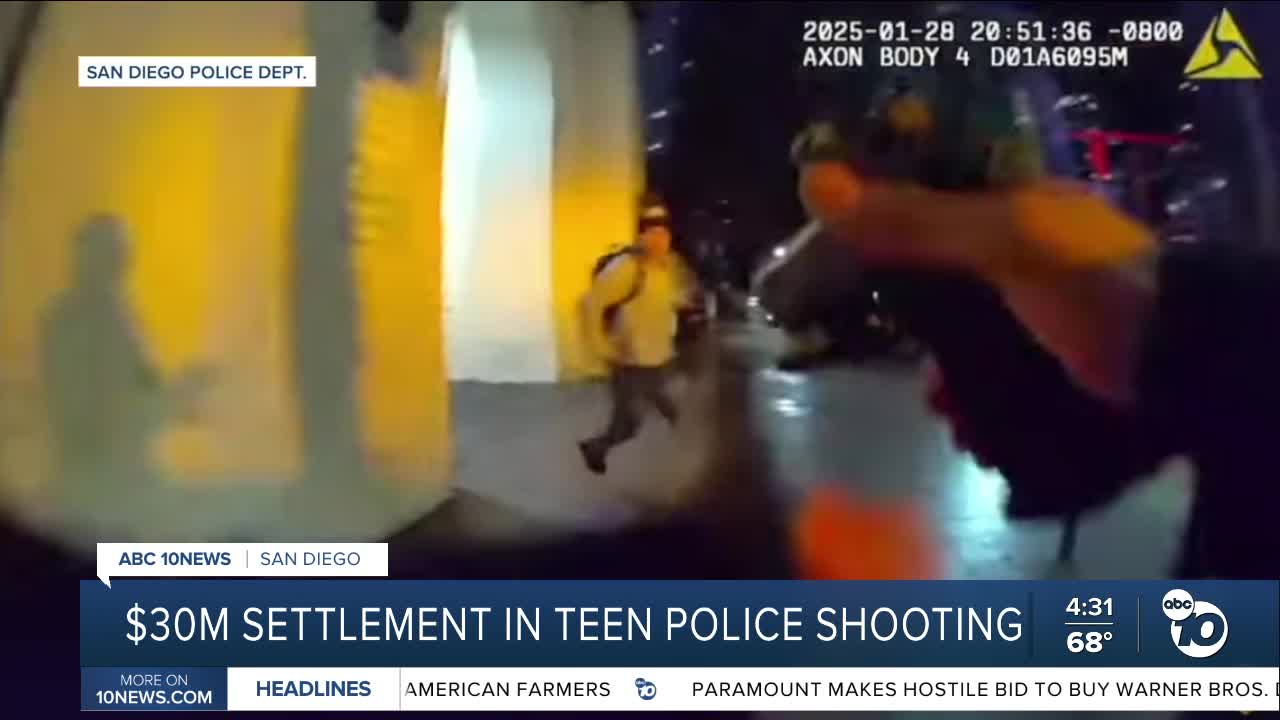


SAN DIEGO (CNS) - The city of San Diego has agreed to pay $30 million to the family of a 16-year-old boy who was fatally shot by a San Diego police officer while the teen was running away from gunshots fired by another person, in what the family's attorneys say is believed to be the largest settlement stemming from a police killing in U.S. history, it was announced Friday.
Konoa Wilson's parents sued the city and the officer who shot him, San Diego Police Department Officer Daniel Gold, in connection with the teen's shooting death on the night of Jan. 28.
According to the family's lawsuit, the boy was fleeing gunshots fired at him by another person when he encountered Gold, who shot the boy twice in the back "instantly, without any warning." Konoa was pronounced dead at a hospital less than an hour later.
Attorneys representing the teen's family say the recently reached settlement figure eclipses the previous largest police killing settlement of $27 million paid out by Minneapolis to the family of George Floyd.
The settlement amount was disclosed in a San Diego City Council agenda posted on Friday and will be formally considered by the council Tuesday. Representatives for the city could not be reached late Friday afternoon for comment.
"What happened to Konoa was a catastrophic failure of policing," the Wilson family's attorney, Nick Rowley, said in a statement. "A 16-year-old boy was running for his life. He was not a threat and not a suspect, yet he was shot in the back by a police officer who only saw him for one second before deciding to pull the trigger."
In trolley station surveillance footage released by the police department earlier this year, Konoa can be seen running after another person pulls out a gun and opens fire on him at the station's west platform.
Gold and another officer were in the area responding to an unrelated report of an assault when the gunshots rang out.
The boy can be seen running down a corridor leading out of the station and emerging on Kettner Boulevard just as Gold was running towards the same corridor.
Body-worn camera footage shows the officer immediately fire on the teen at close range. Rowley said Gold shot the boy "before he even announced who he was."
After he was shot, the video shows the boy screaming and running briefly before collapsing. Officers then began performing CPR on him and, while doing so, found a handgun concealed under the youth's clothing near his right thigh, according to police.
There were no indications in the video that the teen fired his gun during the incident or was holding it when Gold, a two-year member of the police department, opened fire on him.
Rowley said the boy had the gun for self-defense, because he had recently been targeted and assaulted by gang members. The attorney said the gun was not believed to be loaded, but more importantly, was not brandished when he was shot.
"This settlement brings some semblance of accountability, but not closure," Rowley's statement continued. "You don't get closure when your child is shot in the back for doing nothing wrong by the people who are supposed to be protecting him.
"We hope that Konoa's story will send a message across the country: Cities will pay dearly when officers violate the law and take a life without justification. We expect the city of San Diego to ensure this never happens again."
The boy was killed three months shy of his 17th birthday. In a statement, attorneys said he was "an only child, and his parents lost their only son."
Police said the person who fired gunshots at Konoa -- described only as a 16-year-old juvenile -- was arrested just over a week later.
