

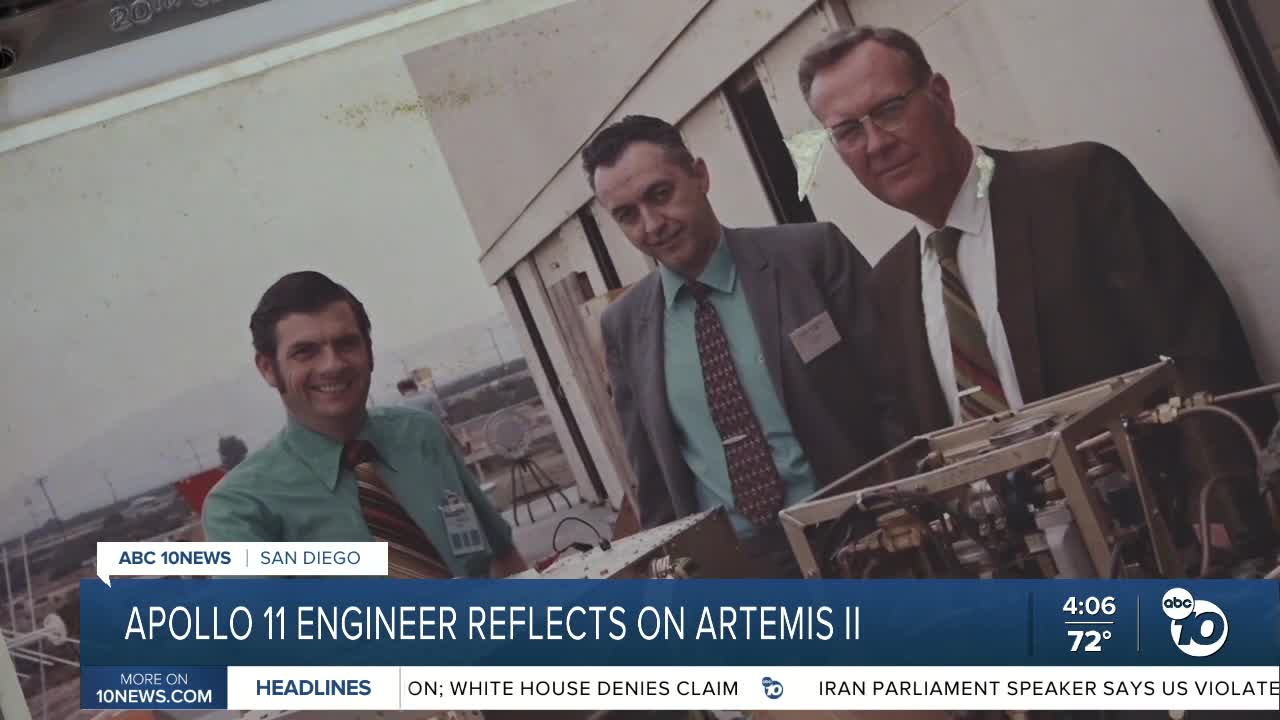


CORONADO, Calif. (KGTV) — A Coronado space engineer who played a critical role in the Apollo 11 moon landing is looking back at the historic 1969 event as NASA's Artemis II mission unfolds.
Ralph Longfellow was the lead project engineer behind the lunar landing radar, which helped guide astronauts like Neil Armstrong safely to the moon.
“They tested the landing radar in orbit, and when the landing radar locked up on the moon on the surface, meaning it was working, we said yes, we did it,” Longfellow said.
During the mission, the radar provided critical data to the crew.
“Neil Armstrong was flying the lunar module but Buzz Aldrin was reading this data off the display to tell Neil Armstrong where they were and how fast they were going,” Longfellow said.
Longfellow said the pressure was immense, as every calculation and test had to be perfect. His job also included training the astronauts on how to use the landing radar.
“We’re not touching anything but I’m pointing out with a pointer different parts and explaining how they work or what they do for the landing radar,” Longfellow said. “I guess I was lucky to do that job. I did that job the best I could."
Decades later, Longfellow is watching history repeat itself with a new generation. NASA’s Artemis II mission sent astronauts around the moon, paving the way for future landings.
“We learned a lot with Apollo we’ll learn a lot more with Artemis we’ll put people on the moon I just hope they have a good landing radar when they go, to land.” Longfellow said.
Longfellow said he is proud of the work people are doing today. He knows the journey to the moon is far from over and is just getting started.
This story was reported on-air by a journalist and has been converted to this platform with the assistance of AI. Our editorial team verifies all reporting on all platforms for fairness and accuracy.
