

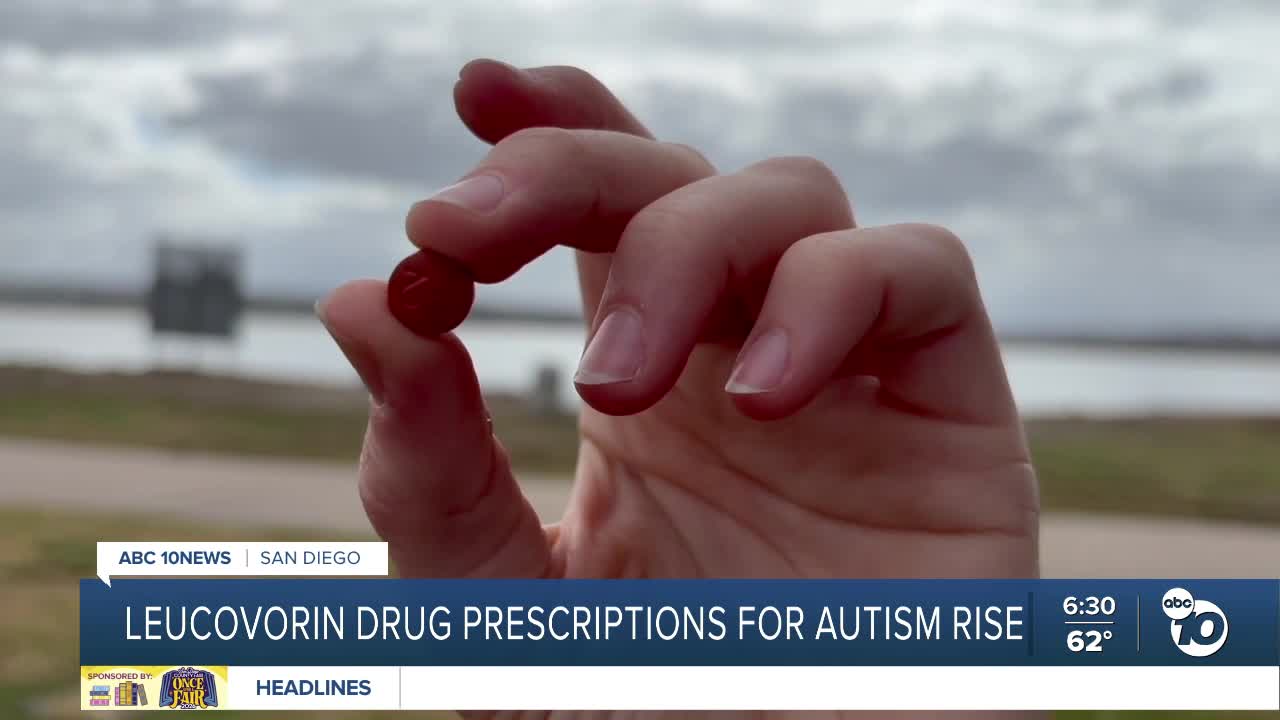


Leucovorin is a 6 mm round pill, a drug that gained initial FDA approval in 1952 and is primarily used to counter the side effects of chemo.
But after the drug got major media attention and promotion by President Donald Trump and Health Secretary Kennedy, now doctors are prescribing the medication for children with autism, even though large-scale studies say the safety and efficacy of the drug are lacking.
There’s been a sharp rise in autism diagnoses in the U.S. over the last two decades. According to the CDC, about 1 in 31 children are identified with autism spectrum disorder.
Experts say that the increase is largely driven by broader definitions of autism, better screening, and improved access to diagnoses in underserved communities.
But as more families search for treatments, a White House announcement back in September brought new attention to a little-known drug called Leucovorin.
The White House promoted the drug as a possible treatment for speech-related challenges associated with autism.
"Families of children who have severe autism are often looking for treatments or anything that can help their child, especially when it comes to verbal skills," Yoshi Rothman, an Assistant Professor of Pediatrics at UC San Diego School of Medicine, says.
Rothman wanted to find out what impact that national attention had: “We wanted to know if it was directly related to when the White House made their announcement that leucovorin was gonna be a treatment for children with autism that had speech-associated deficits.”
His research found prescriptions for leucovorin in children with autism had already started rising earlier in 2025, but after the White House announcement, the numbers spiked.
According to the study, prescriptions jumped more than 70 percent after the President weighed in. Compared to previous years, prescriptions jumped more than 2-thousand percent overall.
But while the drug is FDA-approved for other conditions, the FDA hasn’t approved it as a treatment for autism. They’ve only recently narrowed the drug's approval to a rare condition called Cerebral Folate Deficiency.
“It just goes to show that once people start talking about certain changes or treatments in the media, social media, and definitely when public figures talk about these treatments or medications," Rothman says. "You see that there's a definite impact in the communities and the patients.”
Now, demand for the drug continues to grow. Some reports in 2026 say families are even having trouble filling prescriptions because of increased demand.
That’s why researchers like Rothman say it's exactly why more studies are still needed.
"We're looking for any ways to raise funds so that we can support our researchers to take the time to do the data collection and the analysis," Rothman says.
He warns that without larger long-term studies, many questions still remain about who the drug truly helps and whether it’s safe for widespread use in children with autism that it’s seeing.
