

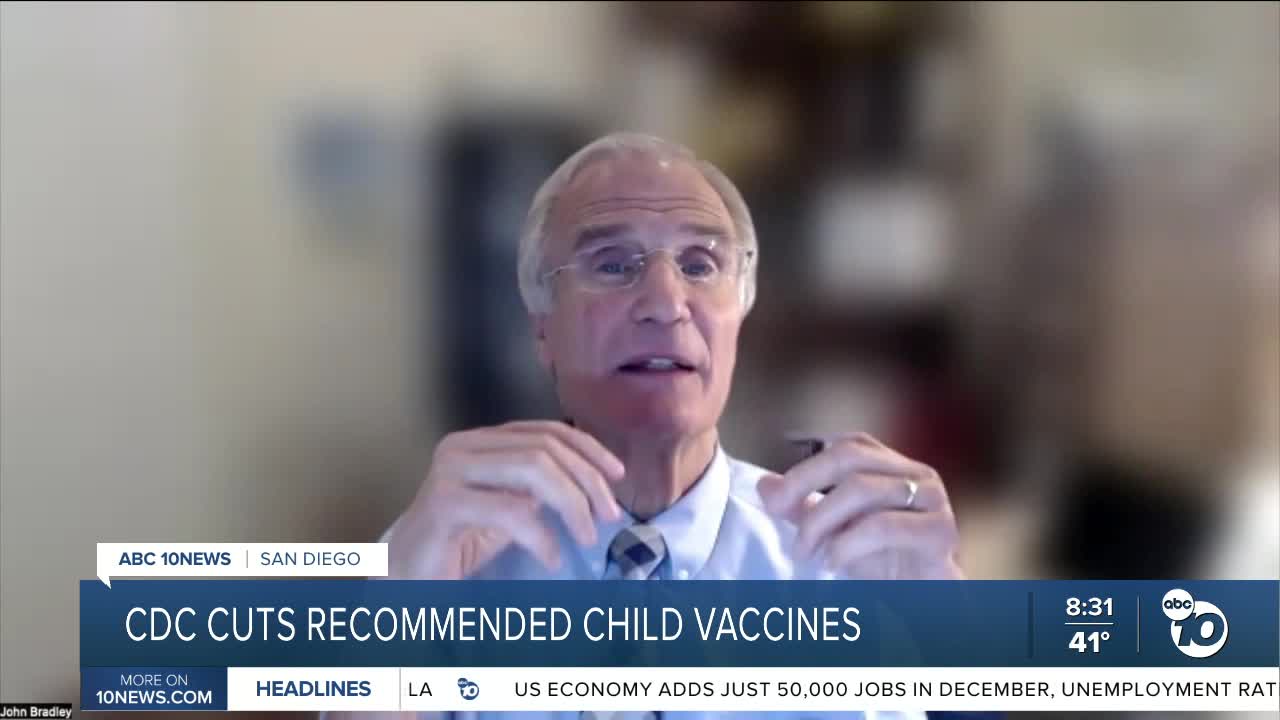


For decades, pediatricians like Dr. John Bradley, Medical Director of Infectious Diseases at Rady Children’s Hospital, have helped shape national vaccine guidance through the American Academy of Pediatrics or the AAP.
"“Everyone contributes, Everyone has a chance to raise their hand and say What about this? What about that?” Dr. Bradley says.
That process grounded in scientific evidence is how the AAP develops its vaccine recommendations, by analyzing risks, vaccine safety, effectiveness, and cost.
Historically, those recommendations have aligned with guidance from the CDC’s Advisory Committee, until now.
This week, the administration released a new federal vaccine schedule, recommendations that often influence what vaccines states require for schools and which shots are covered by insurance.
Under their new guidance, healthy children are broadly recommended to receive 11 vaccines instead of 17.
And Dr. Bradley says how the CDC came out with this recommendation, matters.
"If the CDC had said 'let's have a meeting, let's discuss this, we think the disease recommendations need to be modified', I would have been really happy," Dr. Bradley says.
Instead, he points out they were left out entirely, prompting sharp push back from the American Academy of Pediatrics, whose president called the changes “dangerous and unnecessary.”
“It's dangerous because if you don't give vaccines that we've been giving and have been shown to be safe and effective, and a child ends up in the hospital, that's preventable," Dr. Bradley says.
Now, parents and pediatricians are trying to understand what this means in practice, including whether some vaccines could become harder to access or harder to get covered by insurance.
Some medical offices may take extra steps and doctors worry confusion could undermine trust.
"If we can't recommend it in association with the CDC any longer, that takes away some of the credibility the pediatricians may have," Dr. Bradley says.
So could more change be coming? Dr. Bradley hopes not; "I hope that they learn that this push back from all the professional societies and parent groups, we'll have them think twice about just releasing a policy for vaccines without getting everyone's input."
