

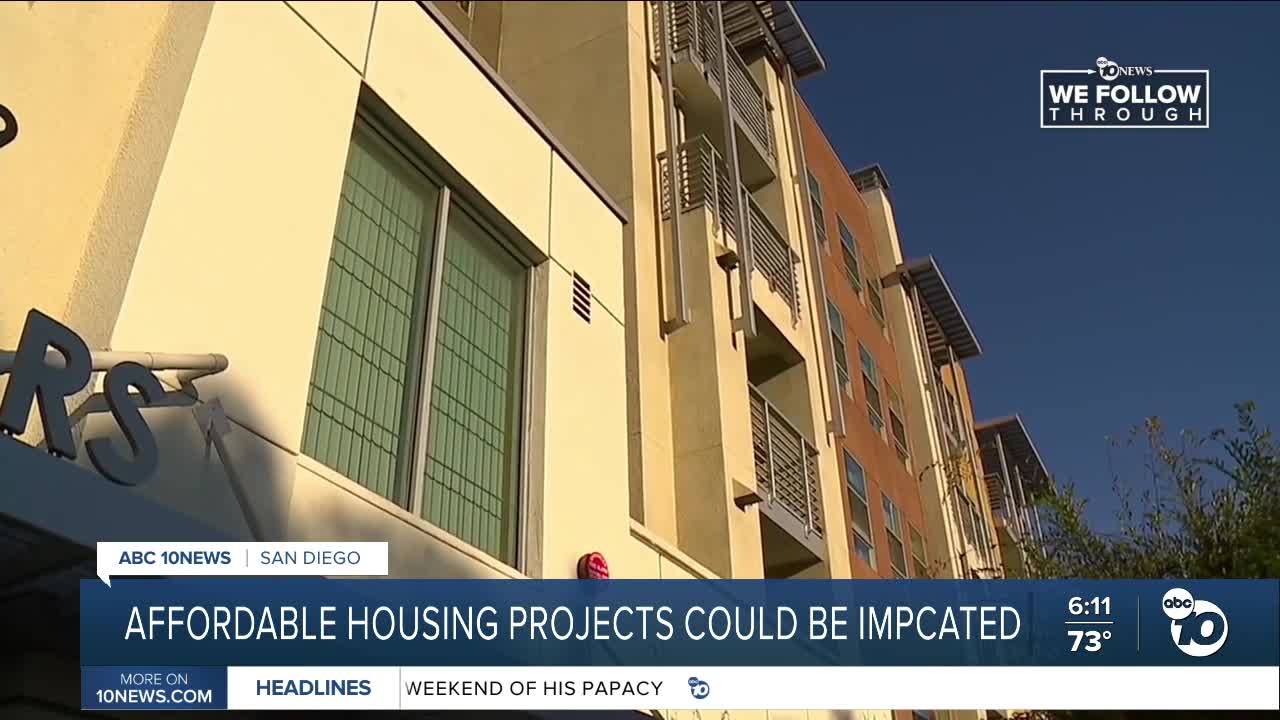


If California runs low on money, affordable housing could be one of the first things to feel it. The state helps fund a lot of these project, so a budget shortfall can mean fewer builds, delays or cuts.
In San Diego where housing is already out of reach for many that could make it even harder for people to find a place they can afford.
“Affordable housing is built on a spectrum we need it at all levels and we don't have enough," President and CEO of the San Diego Housing Commission Lisa Jones says.
She adds that federal cuts, on top of a possible state deficit could put even more pressure on programs that help build low-income housing. Some impacts already happening;
More than 650 San Diego households who were promised rental help through 2030 are now losing that support years early. Their funding comes from the emergency housing voucher program, a program that is now running out of money with local funding expected to dry up as soon as this year.
"That is going to impact those families that are on the lowest income," Jones says. "It's also going to significantly impact the number of resources that are available for families previously experiencing homelessness who need permanent supportive housing, so deep subsidy paired with high levels of services.”
At the same time, lawmakers are trying to speed up housing production. The state senate has passed what’s called the 21st century road to housing act, a plan designed to make it faster and easier to build. But even with that, it doesn’t solve the biggest problem which is money.
If funding isn't there, projects still may not get built; "We definitely have funding challenges right now," Jones says. "We're also seeing the federal government sort of policy priorities change a lot, it's a little hard to identify like where the positives are going to come from and where the negative impacts are going to be.“
So, while new housing is still coming the big question is, will there be enough of it for the people who need it most?
"Our focus is to look at what is the policy that is coming through right now and that we anticipate in the next couple of years and how do we influence that policy so that it has either the least negative impact or the most positive impact that it can have," Jones says.
